Moldova, Ukraine, EU make it easier to move across the Moldova-Ukraine border

Two new cross border cooperation agreements were signed today between Moldova and Ukraine that will make it faster and easier to move across their joint border.    The first, establishing joint control at the Pervomaisc-Kuchurhan Border Crossing Point (BCP) would allow both excisable and non-excisable goods for import, export and transit through Transnistria to move through this BCP.  This will save businesses both time and money, eliminating the need for re-routing any goods, including alcohol and tobacco, around this part of the border and also avoiding double customs clearance in both Chisinau and Tiraspol.   In the longer term, the agreement should also help re-open international transport corridors across Transnistria.

The second agreement, on the automated exchange of border crossing data across the Moldova-Ukraine border, will enhance security through increasing transparency about the movement of vehicles and goods over the border.   It could also remove the obligation for foreign citizens entering Transnistria to register their stay with the Moldovan migration authorities, avoiding the need to travel over to the administrative boundary line on the west side of Transnistria.

The signature of the agreements was witnessed by the Advisory Board of the European Union Border Assistance Mission to Moldova and Ukraine (EUBAM).    EUBAM, which has been working with Moldova and Ukraine to help align them with EU standards of border management, has long advocated these agreements as a way to facilitate border crossing and boost regional development and trade.    EUBAM and other EU bodies assisted border professionals in Moldova and Ukraine with its own best practice experience in the area of establishing joint border control.

The Advisory Board convened in Chisinau to agree the Mission’s future work plan with representatives from the foreign ministries, the border and law enforcement agencies of Moldova and Ukraine, the EU Delegations to Moldova and Ukraine, as well as the EU Advisory Mission to Ukraine, the IOM, the OSCE and UNDP.

Jan Tombinski, EU Ambassador to Ukraine said “EUBAM is an important part of the EU’s efforts to help both countries to implement their Association Agreements with the EU and the related Deep and Comprehensive Free Trade Areas.   We praised what the partner services had achieved so far on this agenda, but noted that there remains a great deal of work ahead of us. Working together, I am confident this can be accomplished.”

EU Ambassador to the Republic of Moldova, Pirkka Tapiola, said: “EUBAM’s contribution to the settlement of the Transnistrian issue strengthens cooperation between Chisinau and Tiraspol on a range of practical matters such as customs, trade, transport and law enforcement cooperation, which are central to supporting regional development and security.”

Welcoming the extension of EUBAM’s mandate until November 2017, Daniela Cujba, Deputy Minister of Foreign Affairs and European Integration of the Republic of Moldova said:  “In the ten years since EUBAM’s launch, it has contributed to the implementation of integrated border management at the Moldova-Ukraine border, institutional capacity-building and other important areas.   We will support EUBAM’s further practical initiatives, which bring concrete benefits for both countries on their path to European integration.”

Volodymyr Bachynsky, Deputy Head of the EU Directorate of the Ministry of Foreign Affairs of Ukraine said: “Ukraine is seeking deeper cooperation with EUBAM in accordance with new challenges and priorities such as the DCFTA which comes into force on 1 January.  We also want EUBAM to provide assistance with combating smuggling and improving enforcement measures.”

Background: 

Among the benefits of establishing a jointly controlled border crossing point at Pervomaisc-Kuchurhan Border Crossing Point is to promote and encourage the re-establishment of international transport corridors across Transnistria and along the M14 which is a European corridor and pave the way for reopening the Gura Bicului – Bicioc Bridge along the motorway M14.  This route is intended to form part of the TRACECA network.  The Transport Corridor Europe-Caucasus-Asia network is an international transport programme involving the EU and 14 countries of the Eastern European, Caucasian and Central Asian regions.
MEDIA ADVISORY: 25th Advisory Board Meeting of EUBAM

You are cordially invited to attend a press conference following the 25th Advisory Board Meeting of the European Union Border Assistance Mission to Moldova and Ukraine (EUBAM).

The press-conference will start at 13.00.

Registration begins at 12.15. Media will be invited for the protocol filming of the meeting at 12.45.

Please arrive in good time.


Venue:  Ministry of Foreign Affairs and European Integration of the Republic of Moldova,

Chisinau, 80, 1989 31 August str.


The Advisory Board is the Mission’s governing body. The 25th ABM will be chaired by the Head of the Delegation of the European Union to Ukraine Ambassador Jan Tombinski.

It is foreseen that the signing ceremony of the Agreement on the information exchange on persons and vehicles crossing the Moldovan-Ukrainian State border and the Protocol on organisation of joint control in the international Pervomaisc-Kuchurhan Border Crossing Point with participation of Moldovan and Ukrainian border agencies will take place.

It is expected that the following speakers will take part:


H.E. Jan Tombinski


Head of the Delegation of the European Union to Ukraine
H.E. Pirkka Tapiola Head of the Delegation of European Union to the Republic of Moldova


H.E. Daniela Cujba


Mr Volodymyr Bachynsky


Deputy Minister of Foreign Affairs and European Integration of the Republic of Moldova

Deputy Director General of Directorate General for the European Union, Ministry of Foreign Affairs of Ukraine


H.E. Andrew Tesoriere Head of EUBAM


Representatives of the United Nations Development Program, International Organization for Migration and the Organization for Security and Cooperation in Europe will also participate in the press conference.


We request and encourage the media to register at their earliest convenience but no later than 1700, Tuesday 3 November 2015. Please bring a valid press-card with you.

Contacts for registration: e-mail: christina.turcan@eubam.org, tel. +373 68 375 975.

Together in the Fight against Tobacco smuggling

On 26-29 October, the Customs Service of the Republic of Moldova organised an international Conference “Together in the Fight against Tobacco Smuggling”. Customs officers and border guards from Moldova, France, Poland, Romania and Ukraine attended as well as the European Anti-Fraud Office (OLAF) and EUBAM. Service dogs were also put through their paces at a competition for detecting tobacco products and drugs.  First places went to Moldova.

The conference focused on the sharing of experience in detecting tobacco and tobacco products, the analysis of current trends in countering smuggling, the exchange of information on tobacco products and their chemical composition.

One of the highlights surrounding the conference was the launch of Moldova’s “Strategy of the Customs Service in the Fight against the Smuggling and Illegal Trade in Tobacco Products for 2015-2018”. The strategy was signed by the Head of the Customs Service, the Director General of OLAF and the Head of EUBAM’s Operations Office.  The Strategy was elaborated in cooperation with EUBAM and in coordination with the representatives of tobacco products producers and OLAF.

Countering customs frauds related to cigarette-smuggling is a priority for Moldovan Customs. EUBAM’s Task Force Tobacco is a cooperation platform which helps the Mission’s partner services – the border, customs and other law enforcement agencies of Moldova and Ukraine – to identify and develop modern mechanisms to counter cigarette-smuggling. The Mission advised Moldova and Ukraine to elaborate and adopt national anti-tobacco strategies, along with accompanying enforcement action plans in order to strengthen counteraction activities.  This will help partner services to fulfil the requirements of their Association Agreements with the EU and the related Deep and Comprehensive Free Trade Areas.

During the conference, new methods for the detection of tobacco and tobacco products were showcased and a competition for service dogs specializing in the detection of tobacco and drugs was held. The Moldovan Customs and Border Police service dogs came first and were recognised as the best in the detection of tobacco products and drugs.

Anti-tobacco smuggling is one of EUBAM’s flagship initiatives.

Task Force Tobacco agrees plans for fighting tobacco-smuggling

EUBAM‘s Task Force Tobacco Group meeting took place in Chisinau on 21-22 October. The event brought together experts from law enforcement agencies in Moldova, Ukraine, Hungary, Poland, Romania and Slovakia, as well as major cigarette producers such as British American Tobacco, Japan Tobacco International, Imperial Tobacco and Philip Morris. Representatives from EU agencies Europol, OLAF and SELEC, as well as the UK HMRC also attended.

The participants presented the latest findings on cigarette-smuggling and cases involving large-scale seizures of tobacco products originating in Moldova and Ukraine. They discussed the strategic aspects of counteracting cigarette-smuggling in the region, including the introduction of the Moldovan and Ukrainian national strategies to step up the fight against the illicit trade in tobacco products. Moldova has finalized its national strategy which will be launched on 27 October while Ukraine is continuing to work on its strategy. The participants also agreed to strengthen counteraction activities against the smuggling of so-called “cheap white” cigarettes via Moldova and Ukraine to the EU, for which there is normally no legal market.

Cigarette smuggling is presently assessed as one of the most serious risks to economic security and security at the Moldova-Ukraine border. Despite the good work being done by local and international law enforcement agencies, the likelihood of the illegal movement of cigarettes through the Moldova-Ukraine border remains high.

Task Force Tobacco was created by EUBAM in 2010 to serve as a platform for combining national and international effort to combat the smuggling of tobacco products from Moldova and Ukraine into the European Union.

OLAF Conference focuses on stepping up the fight on tobacco smuggling

On 13-15 October 2015, Head of EUBAM, Andrew Tesoriere was one of the speakers at the OLAF 20th Task Group Cigarettes Conference in Bratislava, Slovakia. More than 90 experts representing the EU Member States, EUBAM, Europol, Interpol, the World Customs Organization and major cigarette production companies participated in this event. The aim of the Conference was to enhance international operational cooperation and to support the fight against cigarette smuggling and cigarette counterfeiting by information exchange.

The Conference provided a good opportunity for the participants to share information on the latest trends and also sought to formulate plans for improving the effectiveness of anti-smuggling actions in the coming year through improving joint cooperation as well as better use of intelligence and risk analysis to tackle smuggling.

Andrew Tesoriere explained how EUBAM supports its partner services in fighting against cigarette smuggling and invited those participating in the Conference to use the Mission as a platform for communication with Moldovan and Ukrainian services on this issue.

Head of Mission visits Tiraspol, outlines future work plans

EUBAM’s Head of Mission, Andrew Tesoriere visited Tiraspol on 24 September to meet Mr Ignatiev in order to outline EUBAM’s future work plans for 2016-17 and to discuss specific current issues of mutual interest, including regional trade.

At the invitation of Mr Ignatiev, Andrew Tesoriere was accompanied by the senior officers heading EUBAM’s Departments for Border Management, Operations and Transnistrian matters as well as EUBAM’s Heads of its six Field Offices. These Field Offices are located in Ukraine (Kotovsk, Kurchurhan and Odesa Port) and Moldova (Chisinau, Basarabeasca and Otaci).

German MP visits EUBAM HQ

Today, the Head of the EU Border Assistance Mission to Moldova and Ukraine (EUBAM), Andrew Tesoriere, met with Marieluise Beck, a member of the German Bundestag. They discussed business development and trade facilitation and EUBAM’s initiatives in this area. The Head of Mission also gave a briefing on border security and cross-border cooperation in the Mission’s area of responsibility and thanked Ms Beck for Germany’s support for the work of EUBAM.

Marieluise Beck is a member of the Committee on Foreign Affairs at the German parliament and a member of the German-Ukrainian Friendship Group. She is also a member of the Parliamentary Assembly of the Council of Europe.

Deputy Foreign Minister of Poland visited EUBAM

Today a delegation of Polish diplomats headed by Undersecretary of State for Development Cooperation, Polish Diaspora and Eastern Policy Konrad Pawlik visited EUBAM headquarters in Odesa. Acting Head of EUBAM Andrew Tesoriere briefed Polish colleagues on the security situation at the central segment of Moldovan-Ukrainian border, EUBAM initiatives in building confidence across two banks of Dniester River and projects related to trade facilitation.

Mr Pawlik acknowledged the work of the Mission and assured further support for its activity by Poland. The guests also had a chance to meet with representatives of the Polish contingent deployed at EUBAM.

Moldovan and Ukrainian customs authorities coordinate efforts to counteract railway smuggling

Odessa, 26-27 June 2014 – The representatives of customs authorities from Moldova and Ukraine were brought together at EUBAM HQ for a workshop on railway freight customs control. After the 2012 resumption of the railway freight traffic across Transnistria, this was the first event focused on the coordination of activities between the customs bodies of the two countries to ensure better control of the movement of goods over the Transnistrian segment of the Moldova-Ukraine border.

The event was aimed at facilitating cooperation, particularly by increasing the effectiveness of information exchange on railway freight control. The participants, 15 Ukrainian and Moldovan officers from the relevant customs posts discussed procedures and challenges for the railway freight checks.

During the workshop EUBAM presented EU best practices applied in railway freights control. This included an overview of the technical equipment used for customs checks and ways of addressing the risk of smuggling. Measures for counteracting tobacco products smuggling were also discussed by the partner services.

At the conclusion of the workshop the two sides agreed to conduct in the fall a joint exercise on rail freight cargo originating from Transnistria. The exercise would be based on risk selectivity and would apply in practice the methodologies discussed at the workshop.

“This workshop was an excellent opportunity to meet our Ukrainian colleagues in person, learn about their challenges and solutions to overcome them. This is just a first step in our cooperation” – said Andrey Braga, the Head of the Customs Destination Unit of the Customs Service of Moldova. “Principles and methods of customs work are very similar in any country. Coordination of the efforts with Moldovan customs officers and learning about the European experience will help us to enhance counteraction of illegal activities related to railway freight” added Oleg Vishnevskiy, Deputy Head of Rozdilna Customs Post of Ukrainian Customs.

The rail-freight traffic across Transnistria was resumed on 26 April 2012 following an agreement between Chisinau and Tiraspol and the subsequent signing of a protocol on customs control. The protocol took into account the technical proposals developed by EUBAM aimed at resolving the customs deadlock.

Fighting tobacco-smuggling through regional cooperation

The fight against tobacco-smuggling will intensify as a result of an agreement to establish  a regional mechanism for exchanging information on illicit cigarette shipments.  This was the key result of the June meeting  of Task Force Tobacco which operates under EUBAM’s aegis.

This meeting was unique as, for the first time, representatives of Customs Administrations from  Belarus, Georgia and Lithuania joined the Task Force meeting to share their experience with colleagues  from Hungary, Poland, Romania, Moldova, Ukraine, OLAF and SELEC.

Information exchange is crucial for identifying new trends and routes in tobacco-smuggling and working out strategies for counteracting them.  Illegal activities such as tobacco-smuggling are losing many millions of euros from the budgets of regional states.

New Forum to focus on making Odesa ports world class

The Odesa Forum – Business Community convened for the first time on 8 June.  The Forum brings together experts from EUBAM and business organisations and representatives who have an interest in the operation of Odesa’s ports.  The forum will be a platform for promoting and collaborating on trade and logistics issues connected with port operations.  Francesco Bastagli, Head of EUBAM outlined the role EUBAM can play in supporting and assisting business to adapt to and benefit from the extensive reforms to trade procedures required as part of the Ukraine-EU Association Agreement and Deep and Comprehensive Free Trade Area (AA/DCFTA).   The AA/DCFTA will have a major impact on clearance procedures at the port.  It has the potential to speed up trade, drive down business costs, boost regional growth, open up the EU market for Ukraine, and make Odesa’s ports internationally competitive. Topics covered included: the key role of risk analysis procedures and the effective flow of information for speeding up and simplifying trade procedures; legislative issues; and the New Computerised Transit System which will be introduced as one of the requirements of the AA/DCFTA.  An initial plan of work was agreed and the Forum is expected to meet again in July.

EUBAM releases its Annual Report 2014

The reporting year was fraught with uncertainties and difficulties both in the Republic of Moldova and in Ukraine. 2014 was also marked by a development of fundamental importance in the European agenda of EUBAM’s partner countries: the signing by Chisinau and Kyiv of Association Agreements with the European Union.

In a fast evolving environment, EUBAM had to question itself and adjust priorities and programmes. As we did so, we relied on two assets: a well-established cooperation with border control, customs and other national services and our unique on-the-ground presence and expertise.

The diverse requirements of the Association Agendas and DCFTA led to a greater engagement in normative and operational areas of trade, border control and customs work. We also launched dedicated efforts, such as the Odessa port study, intended to act as catalysts for the overall strengthening of partner services. In response to new security concerns at the Transnistria segment of the border, the Mission increased its monitoring presence and reporting capability.

In its ninth year of operations, EUBAM moved determinedly towards the empowerment of partner services and sustainability. Partners took the lead on several activities [that had reached maturity as the Mission limited itself to a supporting and advisory role. This freed time and resources for us to turn our attention towards new priorities. The growing number of initiatives by the European Union and other regional and international partners made it also imperative to strengthen inter-agency coordination. This promoted synergies and the optimal utilization of resources in the best interest of partner countries. The Mission intends to continue down this path.

As reflected in the report, 2014 saw most encouraging progress in cross-border cooperation.  The concern over security shared by both countries reinforced their mutual commitment both institutionally and on the ground. EUBAM was a close partner in joint operations and in facilitating new agreements within the framework of the standards and obligations of the association process.

The political impasse over Transnistria affected EUBAM’s capacity to make full use of its know-how through the confidence-building process. Some glimmer of hope transpired towards the end of the reporting year. At the same time, the Mission presence at the Transnistrian segment of the border was an effective tool to ensure that heightened security measures complied with EU standards. It also provided much needed information on developments to partner countries and the international community.

This report is meant most of all to inform about the activities of EUBAM and its partners during the past year. It should also contribute to the collective effort to define a common agenda for the future. More needs to be done in the fight against corruption and cross-border crime; good intentions must increasingly be reflected in specific deeds and verifiable results. Rules and procedures should be further developed, particularly in the area of human resources management, and aligned with European standards. Equally important is their universal and consistent application. Greater stability of structures and personnel in the partner services would also facilitate continuity and readiness to commit. On Transnistria, the Mission will redouble its efforts to promote practical answers to problems shared by the parties without prejudice to the unresolved political agenda. Open minds and a spirit of compromise on the part of all concerned would be of great assistance in this respect.

While considering what remains to be done, this is also an occasion to acknowledge the important progress that we have made together. The report bears witness to this progress.

Whatever achievement EUBAM managed over the past year would not have been possible without the hard work of our Moldovan and Ukrainian colleagues in circumstances that often were far from easy. As we renew our wholehearted commitment to the common agenda, I wish to express EUBAM’s deep appreciation for their trust and dedication.


Francesco Bastagli

Odessa   January 2015

Europe Day travels to Gagauzia

Comrat, 17 May 2014

“Europe as we know is built on shared values and on cultural diversity. Europe Day is an opportunity to celebrate the richness of these values and our cultural diversity”, the Head of EU Delegation to Moldova, Mr. Pirkka Tapiola, opened the Europe day celebrations in Comrat, the Gagauzian capital.

The Europe Village, organised by EU Delegation, was brought to the Autonomy for the second time. Traditionally the event takes place in Chisinau, but for the last two years it was taken out the capital.  EU-funded projects and European embassies took the opportunity to showcase their countries, culture and cuisine to the people in Comrat.  The stand of EUBAM was also well visited.

The Minister of Foreign Affairs and European Integration, Ms. Natalia Gherman, the Governor of ATU Gagauzia, Mr. Mihail Formuzal, the Chairman of the ATUG People’s Assembly, Ms. Anna Harlamenko and the Mayor of the Comrat city, Mr. Nicolae Dudoglo joined Ambassador Tapiola for the celebrations in the central square of Comrat.

Join EUBAM Photo Competition

To mark Europe Day EUBAM is holding a photo competition.

Authors of 3 shots that collect the most likes will get a gift (a digital photo frame) from EUBAM.

Topic: Exceed your limits – find out what is on the other side of the border

Take photos of landscapes, people and border crossing points

Terms and conditions:

This competition is open to residents of Moldova, Ukraine and EU member States, aged 18 years or over.

Submission of an entry will be taken to mean acceptance of these terms and conditions.

Entries should be submitted via email to press@eubam.org.  Entries must be labelled with the entrant’s name and image files must be 72 dpi and 1 – 3MB. Entrants should include their own name and telephone number. We regret that we are unable to accept postal entries.

EUBAM will retain the copyright of the pictures.

The photo competition starts today and will last until 1 June 2015

All entries must be received by the advertised closing time and date.

MEDIA ADVISORY: 24th Advisory Board Meeting of EUBAM

You are cordially invited to attend a press conference following the 24th Advisory Board Meeting of the European Union Border Assistance Mission to Moldova and Ukraine (EUBAM).

The press-conference will start at 13.30, Thursday, 30 April 2015

Registration begins at 12.45. Media will be invited for the protocol filming of the meeting at 13.15.

Please arrive in good time.

Venue: Reception House, Odessa, Sanatornyy Lane, 2

The Advisory Board is the Mission’s governing body. The 24th ABM will be chaired by the Head of the Delegation of the European Union to Ukraine Ambassador Jan Tombinski.

It is expected that the following speakers will take part:

H.E. Jan Tombinski, Head of the Delegation of the European Union to Ukraine

H.E. Pirkka Tapiola,   Head of the Delegation of European Union to the Republic of Moldova

Mr Vsevolod Chentsov, Director General of Directorate General for the European Union, Ministry of Foreign Affairs of Ukraine

Mr Francesco Bastagli,  Head of EUBAM

Representatives of the United Nations Development Program, International Organization for Migration and the Organization for Security and Cooperation in Europe will also participate in the press conference.

In a given security environment we request and encourage the media to register at their earliest convenience but no later than 1700, Wednesday 29 April 2015. Please bring a valid press-card with you.

Contacts for registration: E-mail: press@eubam.og, tel. 050 391 0904.

State Fiscal Service reinforces its commitment to ports reform

Three months ago, on 29 January, EUBAM in collaboration with the State Fiscal Service of Ukraine presented to the public the major findings of a study on Odesa and Illichivs’k ports.

The study reviewed border control and customs procedures at the ports and made recommendations to improve management and reduce the scope for corruption. Taken together, the recommendations were seen as an action plan with the power to be truly transformative, building ever-more transparent and effective state services and opening up European Union markets for Ukrainian trade.

The report was welcomed by professionals and businesses whose work involves the ports. The State Fiscal Service expressed its commitment to use it as a tool for driving forward modernization and for meeting the customs-related obligations deriving from the EU Association Agenda and Deep and Comprehensive Free Trade Area (DCFTA).

Three months after the launch of the study, EUBAM has taken stock of progress so far. Some efforts to address shortcomings and ensure more effective and transparent operations at the ports have gained momentum. They include norms and standards on authorized economic operators and the introduction of computerized transit systems. Further, in early April the State Fiscal Service tabled a draft roadmap setting out specific action points and deadlines for implementation and seeking EUBAM assistance with aspects of it. Discussions are ongoing between the Service and the Mission on future cooperation around these points.

Francesco Bastagli, Head of EUBAM, said: “The roadmap by the State Fiscal Service is an encouraging development. Many action points are directly connected to fulfilling the customs elements of Ukraine’s DCFTA obligations. With the DCFTA provisionally coming into force on 1 January 2016, it is vital to keep up the momentum. It’s equally important that the ongoing reorganization of the State Fiscal Service and Customs be brought to an early conclusion. Stability and clarity of responsibilities within the Service would help motivate and lead a vigorous implementation of reforms.”

Fulfilling the action plan would bring major economic benefits, including a reduction in operating costs for businesses, making them more profitable and competitive. It would be far easier to trade across borders. This, in turn, would boost growth and investment in the region, increasing revenues to the Ukrainian State budget.

Plans to assist Moldova and Ukraine fulfil AA/DCFTA customs obligations dominate first meeting of EUBAM’s Trade Facilitation Working Group

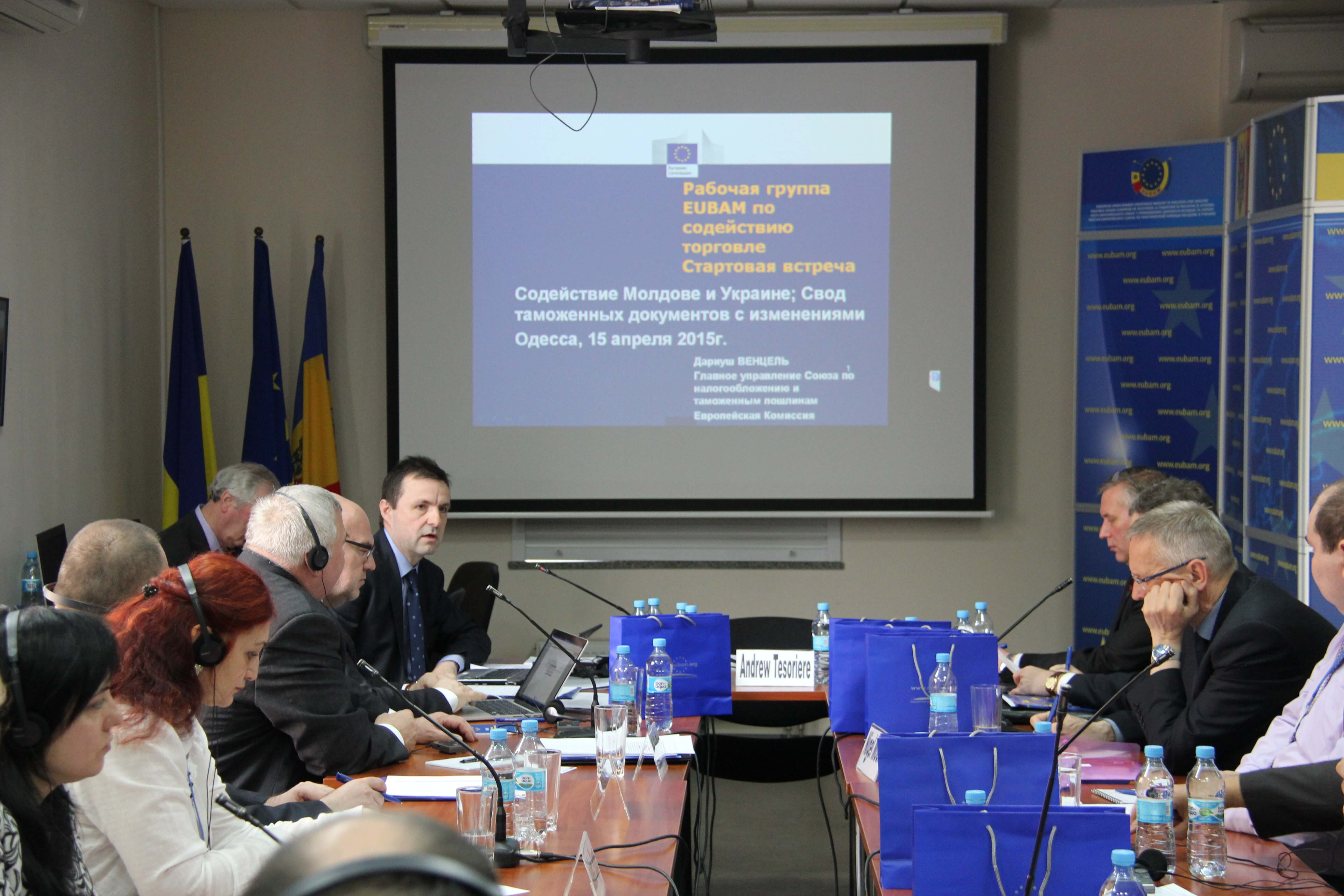
Odesa, 17 April 2015

The first meeting of the Trade Facilitation Working Group established by EUBAM was able to identify key needs for assisting Moldova and Ukraine to fulfil the customs obligations of their AA/DCFTAs with the EU and to put plans in hand for addressing them.

20150417181859343585

The Working Group met on 15-16 April at EUBAM’s HQ in Odesa.  The creation of the Working Group is part of the Mission’s wider efforts to support the customs services of Moldova and Ukraine to implement the customs elements of their obligations under the Association Agreement and related Deep and Comprehensive Free Trade Area (AA/DCFTA) they have signed with the EU.  The meeting brought together experts from the customs services of both states, the European Commission (DG TAXUD), the Customs Department of the Czech Republic, and the BRITE Project (Business Regulatory, Investment, and Trade Environment).

AA/DCFTA commitments require Moldova and Ukraine to harmonise their customs procedures with those of the European Union. The Trade Facilitation Working Group will focus not only on the guidelines for harmonising customs practices, but more importantly on overcoming procedural and operational challenges so that they can be successfully implemented.

The Working Group was able to identify near-term needs for making progress on fulfilling the obligations relating to the introduction of; the Authorised Economic Operators (AEO) concept; a customs debt guarantee system/deferred payment scheme; the New Computerised Transit System, and post-clearance control and audit.   The implementation of these measures will help simplify the customs regimes of both states, cutting down the costs for businesses.  Concrete plans were put in hand to provide assistance; this will include support with infrastructure, legislation and training.

Opening the meeting, Andrew Tesoriere, Deputy Head of EUBAM, said: “The Association Agreement and its related Deep and Comprehensive Free Trade Area are national priorities for Moldova and Ukraine, and equally are priorities for the European Union in terms of trade and cooperation in the wider European space”.

Dariusz Wencel, from the EU’s Directorate-General TAXUD, emphasised that “European experts have knowledge and experience and they are willing to share it and to cooperate with Moldova and Ukraine.”