EU Border Assistance Mission to Moldova and Ukraine launches Liaison Office in Moldova

EU BORDER ASSISTANCE MISSION TO MOLDOVA AND UKRAINE LAUNCHES LIAISON OFFICE IN MOLDOVA

Chisinau, 1 April 2015
2015040615461081959

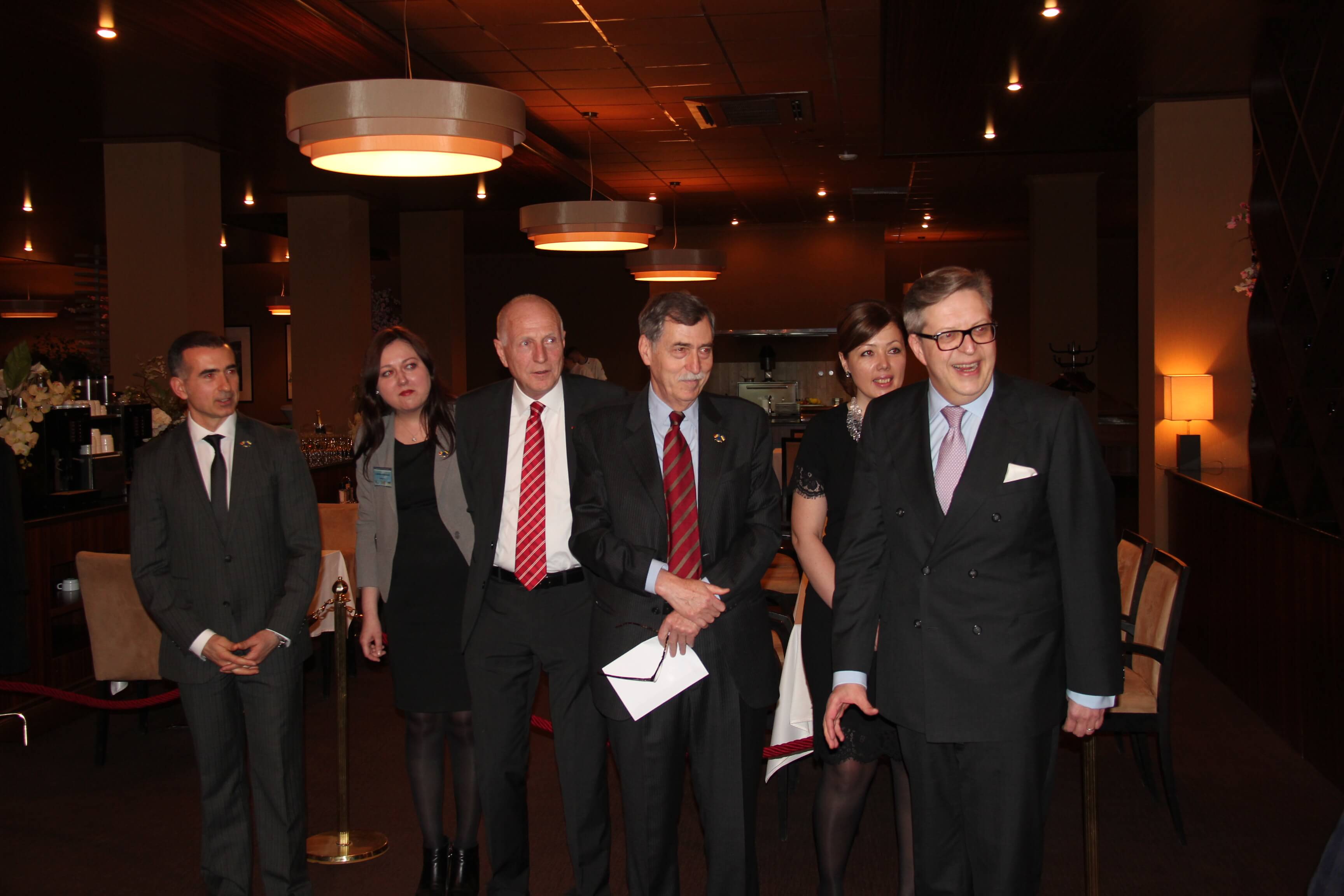
EUBAM’s Liaison Office in Moldova was launched today at an event attended by Victor Osipov, Deputy Prime Minister of the Republic of Moldova, Ambassador Pirkka Tapiola, Head of the Delegation of the European Union to Moldova and Francesco Bastagli, Head of the EU Border Assistance Mission to Moldova and Ukraine.

During his opening speech, Ambassador Tapiola, Head of the EU Delegation, said: ” A functional and active Liaison Office in Chisinau will allow EUBAM to better monitor and assist on border and customs control measures and procedures implemented by the Republic of Moldova in line with the Association Agreement, the Deep and Comprehensive Trade Agreement and Visa Liberalisation Action Plan provisions, and especially give better inputs to supporting the Transnistrian settlement process.”

Deputy Prime Minister, Victor Osipov noted that the all stakeholders interested in border control issues would benefit from the opening of the EUBAM Liaison Office in Moldova.   “On behalf of the Moldovan Government I would like to say that we are working to create the best conditions for the people on both banks of the River Dniester and we will continue to cooperate with our international partners.”

As part of its Association Agreement and DCFTA commitments, Moldova is working to harmonise rules, norms and standards in a number of border control and trade-related areas with those of the EU.   EUBAM, which is fully funded by the EU, is working with its Moldovan partner services, in particular the Customs Service to develop administrative capacity and to align key legislation such as the Customs Code, Rules of Origin, and Intellectual Property Rights protection. The Mission’s unique on-the-ground presence through its six field offices allows it to observe how rules decided at the central level are implemented at the working level.

The Head of EUBAM, Francesco Bastagli said “Moldova is working intensively to fulfil its obligations under the agreements it has signed with the EU.  International donors are likewise working hard to step up assistance to Moldova.  This requires greater efforts amongst all parties to co-ordinate our activities to ensure effective cooperation and avoid duplication.  A greater liaison presence will allow the Mission to respond better to changes in the priorities of our Moldovan partners and to coordinate more closely with other donors. The Liaison Office will be housed in dedicated premises and co-located with the Mission’s Chisinau Field Office.  The Head of the Liaison Office is Andrew Filmer who comes from a career in the British customs service.
Moldovan and Ukrainian security services step up cooperation

The Intelligence and Security Service of the Republic of Moldova (ISS) and the Security Service of Ukraine (SSU) agreed today to step up cooperation in view of increasing risks to regional security. Joint efforts to carry out common assessments of the security threats at the Moldovan-Ukrainian border and to tackle cross-border crime were identified as priorities during the trilateral meeting of security services of two countries and the European Union Border Assistance Mission to Moldova and Ukraine (EUBAM).

Opening the meeting, Francesco Bastagli, the Head of EUBAM said: “The security services of the partner countries and the Mission have enjoyed fruitful cooperation over many years. The current challenging regional security environment makes it more important than ever to make cooperation and information-sharing systems between the two countries work as effectively as possible. The Mission stands ready to assist with technical advice and support to help our partners.”

Mr Vadim Vrabie, Deputy Director of the Intelligence and Security Service of Moldova said: “It is important to emphasize the high level of trust and transparency in our cooperation with the special services of Ukraine and European partners in the area of information exchange and precise coordination of actions during special operations. Nevertheless, the unresolved conflict in Transnistria, as well as the current situation in the Eastern Ukraine continues to give rise to risks and threats for regional security. In this regard it makes sense to consolidate our efforts to guarantee cross-border security”.

Yurii Artyukhov, First Deputy Chairman and Head of the General Directorate on Combatting Corruption and Organised Crime at the Security Service of Ukraine also stressed the importance of stepping up of cooperation among partners as only joint efforts in responding to cross-border and regional threats could have a positive impact on strengthening border security.

SSU and ISS agreed to intensify information exchange and analysis related to the situation at Moldovan-Ukrainian border and adjacent territories. They also agreed to coordinate efforts to counteract smuggling, illegal migration and trafficking of human beings. Special focus was given to the prevention of smuggling of armament and munitions, as well as drugs and precursors.

EUBAM offered Moldovan and Ukrainian partners strategic, analytical and operational support. In particular, the Mission proposed assistance in drafting national strategies and relevant legislation on counteracting the smuggling of tobacco and other goods.

The Security Service of Ukraine expressed an interest in taking part in the implementation of recommendations stated at Odessa and Illichevsk Ports Study, conducted by EUBAM in summer 2014.

This was the seventh trilateral meeting between SSU, ISS and EUBAM.

Moldovan law-enforcers help smash contraband network defrauding EU member states

Astute work by the Moldovan Intelligence and Security Service (MDISS), with the support of EUBAM, has led to the closing down of an international tobacco contraband network defrauding EU member states of millions of euros.

MDISS began to suspect some time ago that large-scale exports of tobacco from several EU member states that were marked up as destined for Moldova never actually crossed the Moldovan border, but were diverted to EU states. Moldovan law-enforcers asked the EU Border Assistance Mission to Moldova and Ukraine (EUBAM) to help establish the contacts and co-ordination necessary to work with EU partners to put an end to the scheme. EUBAM brought the Moldovan agencies together with their Italian counterparts and the European Anti-fraud Office (OLAF). The information-sharing and cooperation established enabled law enforcement agencies in Italy and Germany to dismantle the network late last year.  The contraband network, which was centred on a tobacco factory in the Italian town of Turin, falsely marked up tobacco exports as destined for Moldova as a way to dodge customs duties and taxes.  The scheme is calculated to have cost the Italian budget in excess of €90mn.  Twenty people were arrested following an investigation by the Italian authorities and OLAF last November.

The breaking up of the contraband network underlines the value of Europe-wide cooperation against organised crime.

Major study on Odessa and Illichivs’k ports outlines key steps to boost trade

Kiev, 29 January 2014 – Today the European Union Border Assistance Mission to Moldova and Ukraine (EUBAM) in collaboration with the State Fiscal Service of Ukraine presented to the public the ‘Odessa and Illichivs’k Port Study’. The study reviews border control and customs clearance procedures in both ports and provides a comprehensive action plan for improvement of border management and reduction of potential for corruption in these ports. Such efforts could lead to sharp decrease of operating costs for businesses, increase of their revenues and competitiveness, further facilitate trade across borders and ultimately prompt economic growth and investment in the region.

The study concludes that although progress has been made in specific areas of customs control for the last 5 years, major reforms need to be further carried out, particularly in simplification and modernisation of clearance control procedures and in diminishing the scope for corruption.

The launch of the study was hosted by the Delegation of the European Union to Ukraine. At the opening of the event, the Head of EU Delegation Ambassador Jan Tombinski noted that the “Two seaports are the gateways for regional trade and fast growing exports of Ukrainian goods to its largest markets in the European Union. While customs, borders service and other authorities at the ports are preparing for 1st January 2016, the study proposes concrete measures on how to simplify procedures in order to ease the flow of goods and reduce costs for businesses. Its findings also address steps which could lead to increase of revenues and higher competitiveness of the two ports, namely by eliminating incentives for corruption, increasing inter-agency cooperation and adapting border control and clearance procedures to the EU’s standards and best practices. I look forward to the joint efforts of State’s Fiscal and Border Guard Services, businesses, ports’ management, and EU Border Assistance Mission to implement the comprehensive recommendations of this study”.

“Ukrainian Customs stands for clear, transparent and fast border control procedures of cargo”, stated the Deputy Chairman of the State Fiscal Service of Ukraine Mr Anatoly Makarenko.

The study proposes 29 key recommendations based on EU and international best practice covering 6 strategic areas of reform in the fields of regulatory and institutional framework, human resource development and corruption, operational procedures, information exchange, and infrastructure.

“The study not only makes recommendations for procedural change but, what is especially important, identifies the methods to achieve them”, said the Head of EUBAM, Mr Francesco Bastagli “If properly implemented, the impact of these measures will go beyond the two port operations to ensure ever more efficient, transparent and client-oriented custom services and trade activities throughout Ukraine”.

The study was undertaken by EUBAM since May 2014 at the request of the State Fiscal Service.

Improving the operational efficiency of these ports is of national economic importance. The ports play a key role in export and import of Ukrainian goods and there is greater potential for expansion. Additionally, a significant flow of two-way trade passes through these ports to Ukraine’s neighbouring regions, notably Moldova, Belarus, the Russian Federation; and Kazakhstan. Globally, Ukraine’s international trade partners have a keen interest to see the Odessa region ports’ capacity and efficiency increased.

EUBAM launches ‘My Europe’ drawing competition

In the framework of the annual Europe Day celebrations, the European Union Border Assistance Mission to Moldova and Ukraine (EUBAM) is pleased to announce ‘My Europe’ drawing competition for children from the Republic Moldova, Odessa and Odessa region, Ukraine, aged between 8 and 16 years.

TITLE: ‘MY EUROPE’
All artworks should be developed with the following themes in mind:
• European fairy tale
• The future of Europe
• European values

TERMS AND CONDITIONS OF THE DRAWING COMPETITION:

1. On the occasion of Europe Day – 9 May – EUBAM announces a drawing competition on the abovementioned theme.
2. This competition is open for all children between 8 and 16 years old divided into three age categories: 8-10, 11-13, 14-16 years.
3. Participants should be attending school in the Republic of Moldova or Odessa or Odessa region, Ukraine.
4. Drawings should be focused on one of the themes of the competition, using any artistic technique (watercolours, oil painting, drawing, graphics etc.) NB! Computer graphics or 3D works won’t be accepted.
5. Size of works should be minimum 21 cm х 29.7 cm, maximum 29.7 cm х 42 cm. The drawings are submitted without frames.
6. On the back of each drawing the following information should be written: a caption which would explain the drawing (up to 3 lines) as well as first and last name of the artist, age of the artist, his/her tel. number and e-mail address as well as school’s address and tel. number. Additionally, all participants of the competition should fill in the application form that can be uploaded here.
7. Drawings should be submitted by March 22, 2013, to the following address (Monday to Friday from 9:00 – 17:00):
• For participants from Ukraine: EUBAM HQ, ul. Uytnaya 13, Odessa, 65012;
• For participants from Moldova: EUBAM Field Office Chisinau, 19, Petricani Str., MD 2012.
8. A jury will select the 6 winners in each country. No appeal on the organisation or on the results of the competition will be accepted. The jury’s decision will be final.
9. Prizes will be awarded to the 6 winners in each country. All participants of the contest will receive diplomas of participation.
10. Exhibitions: a selection of 70 artworks from each country will be showcased at an exhibition held at the:
• Greek Foundation for Culture in Odessa – in Ukraine;
• ‘Artico’ Republican Centre for Children and Youth – in Moldova.
11. EUBAM has the right to use the artworks and copies of artworks, submitted in the framework of ‘My Europe’ drawing competition, for non-commercial purposes (publication in booklets, catalogues, calendars, websites, etc.) or any other purposes without notifying or compensating the author.
12. EUBAM will retain the copyright of the pictures.
13. EUBAM will keep all the submitted drawings. Drawings will not be returned to the participants.
14. EUBAM can not be held responsible for force majeure, should the competition be modified or cancelled.
15. Submission of an entry assumes the acceptance of all terms and con
COMPETITION CALENDAR:
Announcement of the competition: 22 January 2013
Deadline for submission of drawings: 22 March 2013
Meeting of the jury panel: 25 March 2013
Informing the participants via e-mail about jury’s decision: by 26 April 2013
Opening of the exhibition and awarding the winners: 9 May 2013

FOR MORE INFORMATION PLEASE CONTACT:
In Ukraine: Ms Dariia Pokhliebaieva,
tel.: +380 482 36 52 74, e-mail: press@eubam.org.

In Moldova: Ms Cristina Turcan,
tel.: +373 68 37 59 75, e-mail: press@eubam.org.

Transit of cigarettes from Odessa and Illichevsk ports to Transnistria drops to zero

Stemming cigarette smuggling has always been one of the priorities for the border guard and customs agencies of Moldova and Ukraine as well as for the EU Border Assistance Mission to Moldova and Ukraine (EUBAM). These joint efforts have led to an impressive decrease in the suspected movement of tobacco products along the Moldovan – Ukrainian border.

Past analysis of trans-boundary movements indicated that the delivery of tobacco products to Transnistria through the central segment of the border with Ukraine greatly exceeded local consumption needs. In the period January-August 2014, more than 11 billion cigarettes and 2,300 tonnes of raw tobacco were delivered to Transnistria, a small territory with a population of approximately 0.5 million inhabitants. This analysis suggested such goods were being diverted illegally to Ukraine. A sharp increase in seized cigarettes by the Ukrainian border services at the central segment of Moldovan-Ukrainian border starting from January 2014 confirmed this presumption.

Based on the results of the analysis, in August – October 2014 EUBAM together with Ukrainian partners carried out a number of exercises aimed at tightening the measures to curb cigarette smuggling. The Mission stepped up its 24/7 monitoring of cigarette and tobacco consignments in particular from Odessa and Illichevsk ports to Transnistria. During this period, EUBAM experts participated in the end-to-end processing of all transit of cigarettes. At the same time, Ukrainian customs authorities required all cigarette consignments to bear the excise marks of the Republic of Moldova and be destined only for those Transnistrian operators which are registered in Chisinau.

This tightening in the transit of tobacco products to Transnistria enabled the Ukrainian customs authorities to detect a number of attempts of illicit transit of cigarettes both in Odessa and Illichevsk sea ports and at the international border crossing points ‘Kuchurgan-Pervomaysk”. The State Fiscal Service of Ukraine reported that these actions and the cooperation with Moldovan customs led to the detention of 2.8 million packs of cigarettes which were shipped in four containers and two trucks.

In November and December 2014 the transit of cigarettes from Odessa and Illichevsk ports to Transnistria dropped to zero (as shown in the graph).

It is premature to suggest an end has come to the smuggling of tobacco products to Ukraine through the central segment of Moldovan – Ukrainian border. The profit motive for smugglers remains high, given the price differentials across the Moldovan, Transnistrian and Ukrainian markets and the increased profit margins in customs duties avoidance. However, EUBAM and its partners are working closely together to stay ahead of any new ways devised by tobacco smugglers to pursue their illegal gains and thereby avoid the payments of proper customs and excise duties.

EUBAM increases its presence at the Transnistrian segment of Moldovan-Ukrainian border

Odessa, 17 December 2014 – The unresolved Transnistrian challenge continues to be a major concern for Moldova and Ukraine as well as for the European Union. Starting from 1 December 2014 the number of border guard and customs experts of EU Border Assistance Mission to Moldova and Ukraine (EUBAM) deployed at the central (Transnistrian segment) of Moldovan-Ukrainian border has increased by 63%, from 19 to 31 experts.

Engagement at the central segment of Moldovan-Ukrainian border and provision of first-hand information about the situation there is an important task specified in the EUBAM’s mandate. In light of developments in the wider region in 2014, the Mission’s role as a neutral observer at this part of the border has become even more important.

Starting from last April, the Mission’s experts have been assisting to ensure that tightened controls, such as second line checks, are carried out in compliance with European standards and with human rights. EUBAM has also been providing first-hand information on developments of public interest at the border to the international community and to the media.

The increased number of experts deployed in Kotovsk and Kuchurgan field offices will allow the Mission to enhance its monitoring and reporting capacities along the entire central sector of Moldovan-Ukrainian border and to better address specific challenges occurring at that segment including counteracting smuggling and providing on-the-job training, tailored to the explicit needs of EUBAM’s partners in border management.

“The increase in EUBAM’s presence particularly along this part of the border aims both to allay security concerns while also supporting a better service to members of the travelling public”, Andrew Tesoriere, Deputy Head of Mission commented.

In the near future EUBAM is planning to open a new sub-office to reinforce monitoring of the northern part of the Transnistrian segment of Moldovan-Ukrainian border both at border crossing points and along the green border.

EUBAM hosts the GUAM trade facilitation meeting

Following the previous request of the State Fiscal Service of Ukraine (SFS), EUBAM hosted the 21st sitting of the GUAM Steering Committee in the framework of the Project on Trade and Transport Facilitation at the Odessa HQ on 17-18 December 2014.  The representatives of customs authorities of Georgia, Ukraine, Azerbaijan and Moldova discussed a number of joint initiatives.

Mr Makarenko, Deputy Head of the State Fiscal Service of Ukraine, highly appreciated EUBAM’s close cooperation and partnership with Ukrainian and Moldovan Customs and recognised the role of the Mission as  being “very important” to their work. Mr Makarenko described the situation in the customs-related part of the activities of the State Fiscal Service of Ukraine and listed achievements reached within the last six months during his chairmanship of the customs domain. “The GUAM Conference is not only important in terms of exchange of professional information between Customs services of the participating states but also the moral dimension is very important — representatives of GUAM countries are here together” he said.

EUBAM delivered a presentation on cooperation in the area of trade facilitation and provided representatives with the projects offered to the Partner Services. These include assistance in the creation and leading of a joint working group of Moldovan Customs and SFS of Ukraine on trade facilitation, implementation  and mutual recognition of the Authorized Economic Operators Programme, implementation of the WTO Trade Facilitation Agreement and facilitation of communication between Customs, importers, exporters and professional bodies (Chamber of Commerce, Trade Associations). EUBAM also offered its experience and proven technical solutions to be considered by GUAM Members for possible cooperation in future.

The EUBAM initiative was well received by the Partner Services. Representative of the Moldovan Customs suggested including in the plan of the working group the Azerbaijan Project implemented in the framework of the WCO Time Release Study project.

Project on Trade and Transport Facilitation of the Organization for Democracy and Economic Development of Georgia, Ukraine, Azerbaijan and Moldova (GUAM) focuses its efforts at simplification and speeding up customs clearance procedures for goods and transport means which cross the state border of participating countries.

New Deputy Head of Mission

01 December 2014 Ambassador Harcourt Andrew Pretorius Tesoriere is taking up his duties as the Deputy Head of EUBAM.

Ambassador Tesoriere is a former senior British diplomat and specialist in security, trans-boundary, governance and Islamic issues. He has served as British Ambassador to Albania, Algeria and Latvia; and Charge d’Affaires to Afghanistan and Syria. He was Director of the UN Special Mission to Afghanistan from 1998-2000, where he mediated between the Taliban administration and their opponents, developing confidence-building measures and chairing key peace talks in 1999. He was Head of UN Humanitarian Field Operations in Afghanistan from 1994-95. More recently from 2008-12 he served as Head of the OSCE Mission in Kyrgyzstan, where he chaired the standing OSCE-UN-EU troika focussing on reconciliation issues. Previously he was NATO’s senior policy advisor in southern Afghanistan from 2007-8. Andrew has served in the UK Armed Forces, as Executive Chairman of the OSCE postgraduate Academy and studied diverse languages, including French, Russian, Arabic, Spanish, Farsi, Pashto, Latvian and Albanian.

Moldovan and Ukrainian journalists receive awards for reporting border issues

Odessa, 13 November, 2014: Awarding ceremony of the competition for media ‘Modern border and a new role of border guard and customs agencies’ took place today at EUBAM HQ. The media reports received for the competition reflected events the Moldovan and Ukrainian border agencies faced this year: Ukrainian State Border Guard Service trained officers to meet new challenges in the East of Ukraine, Moldovan Border Police introduced a new Code of Conduct, and Ukrainian and Moldovan customs authorities implemented new IT assisted customs clearance and Moldovans enjoy visa-free travel to EU countries.

The jury panel which included representatives of EUBAM and the partner services of the Mission selected the best reports. The Head of EUBAM, Mr Francesco Bastagli awarded the winners with diplomas and special prizes.

The competition was organized jointly by EUBAM and partners, the Customs Service and the Border Police of Moldova, the State Border Guard Service and the State Fiscal Service of Ukraine, and was held on 4 July – 3 October 2014. It was open for representatives of print, TV, radio, and on-line media from Moldova and Ukraine. The goal of the competition was to raise awareness of Moldovan and Ukrainian public on reforms that the border and customs agencies are undertaking, security situation at the border and how the EU supports border management in Moldova and Ukraine.

Danish Minister of Foreign Affairs visits EUBAM

Yesterday, the Danish Minister of Foreign Affairs, Mr Martin Lidegaard, and the Ambassador of the Royal Danish Embassy to Ukraine, Ms Merete Juhl visited EUBAM in Odesa. The Head of EUBAM, Mr Francesco Bastagli gave the delegation an overview of the current activities of EUBAM. The security situation at the Moldova-Ukraine border and the Mission’s role in promoting a peaceful settlement of the Transnistrian conflict were also discussed during the meeting.

Moldovan Border Police improves skills in fighting human trafficking

In mid-October, EUBAM experts carried out advanced level training sessions on trafficking in human beings for mobile unit officers of Moldovan Border Police from the Regional Directorate East, Regional Directorate South and Regional Directorate West.

The training event was divided into two parts, theoretical and practical. The theoretical part focused on differentiating between trafficking, human smuggling, illegal migration and prostitution. Just recently, the Moldovan Criminal Code was improved to have clear definitions for these terms.

As gathering valid information is vital when detecting victims of trafficking, during the second part of the training, the officers practiced how to interview people. The participants also tried memory techniques and ways to work better with interpreter.

The training sessions came as a continuation of the basic level training provided earlier this year on the same topic.

EUBAM Advisory Board assesses progress in border management and discusses future strategies

Chisinau, 9 October 2014: The period from May 2014 to September 2014 has been busy for the EU Border Assistance Mission to Moldova and Ukraine (EUBAM), a range of successes achieved in cooperation with its partners – Moldovan and Ukrainian border and customs agencies. Since May, controls were tightened at the Transnistrian segment of the Moldova-Ukraine border. The Mission helped ensure that the second line checks were carried out in compliance with European human rights standards.  EUBAM strengthened its monitoring and reporting capacity and assisted its partners in performing their tasks in securing the border.

Significant progress was achieved in border demarcation.  Just 3.1 km of the Moldovan-Ukrainian border remain to be demarcated, out of which 2.8 km belong to the central segment of the border. Over the summer months, Moldova and Ukraine successfully concluded their twelfth joint border control operation OLVIA, which was carried out in cooperation with EUBAM. The operation led to some 140 interventions and the value of goods seized is estimated at about one million Euros.

EUBAM reported its activity and discussed future strategies during the 23rd Advisory Board Meeting.  The meeting in Chisinau, Moldova, was attended by representatives from the EU delegations in Moldova and Ukraine, the Foreign Ministries, border and law enforcement agencies of Moldova and Ukraine and relevant international organizations. The Head of EU Delegation to Ukraine Ambassador Jan Tombinski chaired the meeting.

“We have witnessed a historical moment with the signature and ratification of the Association Agreements between the EU and Moldova and EU and Ukraine. It opened new opportunities and challenges for the region”, said the chairman Ambassador Tombinski. “We considered how the Mission could support Moldovan and Ukrainian border and customs authorities in that area”, he added.

“During the last five months of the Mission’s activity, significant progress has been made in the management of the joint Moldovan-Ukrainian border, particularly, in joint operations, capacity building and training events for the partner-services of Moldova and Ukraine”, the head of the Moldovan delegation, the Deputy Minister of Foreign Affairs and European Integration of the Republic of Moldova noted at the meeting. In this context, the Deputy Minister highlighted the importance of EUBAM assistance for the partner-states in the process of establishing the Deep and Comprehensive Free Trade Area (DCFTA) between EU and Moldova and EU and Ukraine, as well as in other areas.

“The current situation in the eastern and southern parts of Ukraine has significantly changed and increased the relevance of EUBAM’s activity”, said Mr Volodymyr Bachynsky, Deputy Director of the Directorate on European Union of the Ministry of Foreign Affairs of Ukraine, and thanked EUBAM for supporting Ukraine moving towards European integration.

The Advisory Board took note of the report on EUBAM’s activity, on the update of the demarcation process and the security situation at Moldovan-Ukrainian border. Further empowerment of the Moldovan and Ukrainian partners was encouraged to ensure long term sustainability of the progress achieved.  The Board also welcomed EUBAM support to the partner services in the area of border control, visa liberalization and enhancement of their institutional and operational capacities. Both heads of the delegations of Moldova and Ukraine expressed their support to the extension of the Mission’s mandate beyond November 2015. The next meeting of the advisory board will take place in spring 2015 in Odessa.

The European Union Border Assistance Mission to Moldova and Ukraine was launched in 2005 to promote border control and customs norms and practices that meet European standards and to serve the needs of Moldovan and Ukrainian citizens and trade. EUBAM activities help advancing economic development and enhancing border security.

Сотрудничество правоохранительных органов и частного сектора крайне необходимо в борьбе с нарушением авторских прав

25 и 26 сентября, на семинаре по защите прав интеллектуальной собственности, который прошел в Миссии, выступили представители частных компаний. Более тесное сотрудничество частного сектора с правоохранительными органами может сделать борьбу с нарушением авторских прав более эффективной. 

Во время  проведения первой части семинара, организованного для украинской таможни и полиции, несколько компаний представили, как отличить подделку и оригинал. Повышение узнаваемости бренда играет ключевую роль в борьбе с подделками и нарушениями прав собственности. Но только этого недостаточно.

«Одним из наиболее важных способов борьбы с поддельными товарами  – сотрудничество с правоохранительными органами и организациями, такими как Всемирная торговая организация», – говорит главный докладчик, господин Александр Пахаренко, адвокат из «Пахаренко и партнеры» на презентации в Одессе.

Юридическая контора «Пахаренко и партнеры» является ключевым игроком на поле сохранности интеллектуальных прав собственности в Центральной Европе. Они принимали участие в подготовке отчета Международной торговой палаты «О действиях бизнеса, направленных на прекращение фальсификации и нарушений авторских прав», который был представлен в ходе семинара. Отчет, описывающий ценность  интеллектуальной собственности в Украине и предлагающий исчерпывающие рекомендации на политическом и законодательном уровнях, является важным инструментом в улучшении законов Украины в области прав интеллектуальной собственности. 

Миссия организовала этот семинар при поддержке юридической компании «Пахаренко и партнеры». Кроме того, в семинаре приняли участие и представители сети по борьбе с подделками REACT. REACT имеет двадцатилетний опыт работы  в области борьбы с фальсифицированной продукцией.

A new landmark in Moldovan-Ukrainian border control cooperation

On 19 September, Moldova and Ukraine successfully concluded their twelfth joint border control operation carried out in cooperation with EUBAM. The operation, code-named Olvia, took place along the Moldovan-Ukrainian border between June and September 2014. It involved Ukrainian and Moldovan law-enforcement agencies, Europol, Interpol, Frontex, the Southeast European Law Enforcement Centre (SELEC) and border police and customs officials from Hungary, Poland, Romania and Slovakia.

Operation Olvia addressed border control concerns ranging from illegal migration and human trafficking to smuggling and the violation of intellectual property rights. It led to some 140 interventions and the seizure of vehicles, alcohol, cigarettes, weapons, psychotropic substances and consumer goods. Twelve illegal migrants were detained and a cannabis cultivation area was identified in the border region. The value of goods seized is estimated at about one million Euros.

Beyond its sectorial successes, Olvia offered an opportunity to improve control practices at border and inland locations, increase mutual knowledge and trust between Moldovan and Ukrainian law-enforcement officers and between them and all other international partners involved. The remarkable progress in threat identification and exchange of actionable intelligence was clear evidence of the high-level of border, police and customs cooperation.

In congratulating participants for the excellent outcome of the exercise, EUBAM Head of Mission, Mr. Francesco Bastagli, said, “Given the results achieved in recent years, we should now move towards further empowerment of the Moldovan and Ukrainian partner services. Such joint operations should increasingly be defined and managed by them. EUBAM will be there to help down this road to self-sufficiency, as appropriate”. Among the measures considered for the next round of exercises in spring 2015 are the total devolution to the Moldovan and Ukrainian services of the definition of the operational plans and the hosting of the Operation Coordination Units within the partners’ premises.

The European Union Border Assistance Mission to Moldova and Ukraine was launched in 2005 to promote border control and customs norms and practices that meet European standards and to serve the needs of Moldovan and Ukrainian citizens and trade. EUBAM activities help advancing economic development and enhancing border security.

Oscar goes to the Moldovan Customs!

“The owners did not want to keep their German shepherd puppy, because he was too lively for the lifestyle of a family expecting a third child. So they offered him to me. The moment I saw Oscar, I knew that he would be the one for me, and the one for this job. And that’s how I got Oscar”, tells the chief inspector Veaceslav Gira, captain of the Moldovan Customs.

Eight months of training at the Ocnita Dog Handling Centre, and now Oscar is one of the 20 sniffer dogs of the Moldovan Customs. Like all other detection dogs he has working hours, lunch breaks and even a salary which is given in dog food. At the age of ten, Oscar can either retire on a pension or continue his duties if he is healthy enough.

On average, dog’s sense of smell is 5,000 times more sensitive than that of human beings. Which explains easily why dogs are used to detect illegal substances. The trained sniffers can detect even the slightest smell of drugs, explosives or weapons. However, this is not only because of the sense of smell they are born with but because of the professional training their go through.

The breed is not relevant – German shepherds, poodles, malinois, Labradors, retrievers and spaniels can all equally well find forbidden substances. What matters most is the dog’s temperament. The playfulness is the key quality for a sniffing dog, so it is tested first. If the puppy likes playing with a toy, fetches it, and tirelessly looks for the hidden toy, it can become a good sniffer. The whole training process is based on a game. Firstly, the dog is trained in the basic obedience skills, where the toy serves as the reward for good performance. Later on the dog gets used to the fact that the toy has its specific smell – the smell of a drug ­– and learns to find it in various hidden places.

“The smell of marihuana, which was collected a month ago, is different from the smell of marihuana collected a year ago“, explains Mr Popovici, the Head of Ocnita Dog Handling Center of the Customs Service of Moldova. “To be effective, the dog should be able to recognize as many smell variations of illegal drugs as possible.”

However, the dog can perform only if teamed with the handler. It’s the handler who analyzes the risks and leads the dog in its search. It is vital for a good canine team to trust and understand each other. At the end of the day it’s the handler’s responsibility to interpret the dog’s behavior and to recognize even the slightest changes which could give away dog’s interest in the smell.

Reaching understanding and trust are at the heart of canine exercises.  Just like the one which took place in mid-October in Ocnita, northern Moldova, on the initiative of EUBAM and Ocnita Dog Handling Center of the Customs Service of Moldova. The two day operational exercise brought together canine teams from the customs services of Moldova, Ukraine and Romania.

“It is a unique event for us, since it’s the first time when all three services meet to share their experience in dog handling and to learn from each other”, says Victor Popovici, the Head of Ocnita Dog Handlers Centre and the main driving force of the event.

“For instance, traditionally when the dog finds something, it signals by scratching. Not only it might be dangerous for the dog, it also might destroy the fingerprints or other microtraces of the trafficker, what significantly complicates further investigation. There is a new method of training the sniffing dogs – to freeze when it detects something. It’s much safer. We will use this technique to train our new puppies”, Mr Popovici continues.

During the operational exercise the canine team from three different countries had a chance to test their skills in detecting drugs, cigarettes and explosives in real life situations such as trains search and vehicles search together with mobile customs units. But what was even more important for the canine teams was the possibility to receive the feedback from their foreign colleagues and to discuss the most effective dog handling technics used by their partner services abroad.

Students conduct traveller survey in Mogilev

On September 17, the students of Mogilev Podolskyi Medical College helped to conduct the Anti-Corruption Client Satisfaction Survey at Otach-Mogilev Podolskyi border crossing point.

At the border, the students interviewed drivers and their passengers, truck drivers and pedestrians. During the day, 200 people crossing the border participated in the survey.

The survey will enable EUBAM and its partners to assess the level and the nature of corruption, if any, and identify the areas where anti-corruption measures should be strengthened.  In addition, the young people participated in the survey had an excellent opportunity to learn more about corruption and the ways to prevent it.

The event is a continuation of the previous surveys by EUBAM and its partners within the ‘Model Border Crossing Point Pilot Project’ at the Tudora-Starokozache and Otach-Mogilev Podolskyi border crossing points.

Ongoing review of the visa liberalization plan for Ukraine

Today EUBAM welcomed experts from European Union Member States, the European Commission, Frontex and the EU Delegation to Ukraine, who travelled to Odessa to examine the state of implementation of the plan for visa liberalization which was launched by Ukraine in November 2010. The team will later travel to other regions of Ukraine and conclude its country-wide review by 26 September.

EUBAM supports this evaluation in the framework of the EU-Ukraine visa dialogue. At events held in Kiev and Odessa, including field visits, the Mission is assisting in the assessment of the progress made in the cross-border movement of people. This relates to such issues as border management, including cooperation among national agencies and cross-border cooperation, risk analysis of the threats posed by organized crime and traffickers, illegal migration and readmission.

Visa liberalization is one of the initiatives intended to promote people-to-people contacts. It is a key joint pursuit of the so-called Eastern Partnership between the European Union and non-EU members to the East of the Union. As the required conditions are met, Ukrainian citizens will gradually benefit from a visa-free regime when travelling to EU countries.

August 2014: Developments at the Ukrainian-Moldovan border

Odessa, 1 September 2014. Following is an outline of selected developments at the Ukrainian-Moldovan border during the month of August 2014.

Enhanced controls.

On 1 August, the Head of the State Border Guard Service of Ukraine issued an order to reinforce controls at the Transnistria segment of the Ukrainian-Moldovan border. Male citizens of the Russian Federation between 18 and 60 years of age entering Ukraine through that segment must routinely undergo second-line checks. All vehicles have to be subject to a more thorough examination, including through use of canine units and detection equipment. Special attention must also be paid to vehicles entering Ukraine in transit.

During August, Mission experts observed an increase in second-line controls and in refusals of entry based on interviews. Compared to July, the number of refusals along the Transnistrian segment of the border tripled to approximately 360. However, in percentage terms this corresponds only to slightly more than 0.1% of overall crossings. EUBAM experts participating in second-line interviews confirmed their compliance with the Ukrainian legislation and EU human rights standards.

Trenches progress along the Transnistrian segment of the border.

The Transnistrian segment is 453.4 km long, representing slightly more than a third of the overall Ukrainian-Moldovan border. Since mid-July, Ukraine has been reinforcing border control installations and digging trenches in selected locations along that segment. By the end of August, the trenches measured approximately 14 km overall. Their width is between 3 and 4 m and their depth can reach 4 m. Naturally-obstructive areas such as swamps are not included in the undertaking.

Increased Belarusian demand for Moldovan produce.

Following the 21 July Russian Federation ban on import of farm products from Moldova, the EUBAM Field office in Otaci/Mogiliv-Podilskyi observed an increase in the export of Moldovan apples and plums towards the Republic of Belarus. Export of plums increased almost six times and that of apples 24 times. The average price for apples remained steady while plums prices dropped by 20% over August 2013. Exports of grapes and peaches towards Belarus have decreased.