EUBAM Statement on joint control at Kuchurhan-Pervomaisc border crossing point

EUBAM regards the introduction of joint operations at the Kuchurhan-Pervomaisc border crossing point, which started on 17 July, as proof of the good cross-border co-operation between the Republic of Moldova and Ukraine.

This jointly operated border crossing point should further regularise and facilitate trade between both countries, to the benefit of all inhabitants of the region, in particular the business community at large, be it in Ukraine or operating on both banks of Nistru river. It should also ease movement of goods in both directions.

Joint operations at Kuchurhan-Pervomaisc border crossing point does not represent a new initiative, but rather progress in fulfilling the inter-state agreement signed between the Republic of Moldova and Ukraine in March 1997.

EUBAM’s role at the common border between the Republic of Moldova and Ukraine continues to be – as it has since its creation in 2005 – a technical and advisory role, at the request of the Moldovan and Ukrainian Government. EUBAM under its mandate has no executive or decisional competence.

EUBAM Advisory Board agreed on the extension of the Mission’s mandate

EUBAM’s Advisory Board, meeting in Odesa today, agreed to the establishment of a new EUBAM phase starting from December 2017. The new-look Mission will be streamlined and focus on supporting technical confidence building measures between Chisinau and Tiraspol, combatting cross-border crime, and full implementation of Integrated Border Management.

Chairman of the Advisory Board, and Head of the EU Delegation to the Republic of Moldova, Ambassador Pirkka Tapiola, underlined that “EUBAM 12 will be focused on Confidence Building Measures, full implementation of Integrated Border Management, as well as cross-border crime. The new mission, lasting until November 2020, will be downsized, nonetheless it will be more targeted and more results oriented. As partners and friends, we should jointly make all possible efforts to implement the benchmarks we set and to achieve the concrete results which our citizens expect.”

This sentiment was echoed by Deputy Minister of the Republic of Moldova’s Ministry of Foreign Affairs and European Integration Ms. Daniela Morari, who welcomed “the extension of the EUBAM mandate and we express our certainty that the prolonged mandate will build upon the achievements made by Moldova’s border agencies with EUBAM support to date.” She also underlined that the joint border control on the Moldova-Ukraine border remained one of the key priorities for the Republic of Moldova before the end of EUBAM’s current mandate on 30 November 2017.

The Advisory Board also took stock of the challenges and opportunities facing the Mission and its Moldovan and Ukrainian partners before the end of November 2017. Participants in the meeting agreed to intensify efforts on areas including anti-smuggling efforts, improvements in the passenger rail link between Chisinau and Odesa, and the introduction of a system allowing for the automated exchange of traveller data.

Martin Klaucke, the representative of the EU Delegation to Ukraine, underlined the “importance to build on the broad advice and pilot projects provided by EUBAM for the last 12 years, in order to roll out best international practices of Integrated Border Management and Joint Border Management throughout the whole territory of the Republic of Moldova and Ukraine. He stressed that International technical assistance could facilitate reform processes and transfer of expertise, but it remained important that stakeholders in both the Republic of Moldova and Ukraine take up the implementation of reforms by themselves. The close cooperation of the two countries with a number of experts from EU Member States provides a good opportunity for peer to peer exchange of experiences.”

Joint control of border crossing points on the common border was a prominent theme of the meeting. Participants agreed to work towards the functional establishment of joint control at sites including Palanca-Maiaky-Udobne, Reni-Giurgiulesti, and Kuchurhan-Pervomaisk, in a citizen and business-friendly manner. Mr. Serhii Saienko, Deputy Director General of the Directorate for the European Union of Ukraine’s Ministry of Foreign Affairs emphasised that, “Ukraine stands for prolongation of the presence of European Union at the State border of Ukraine. We believe that EUBAM should continue monitoring the situation at the Ukraine-Moldova border, providing support in rapid reaction on new challenges in border area and in raising effectiveness of the border and Customs agencies of both countries in line with European standards. Further EUBAM efforts should be concentrated on joint border crossing points.”

The recent decision of visa-free travel for Ukrainian citizens to the Schengen Area and EU countries was also singled out for praise. Head of EUBAM, Ambassador Andrew Tesoriere congratulated the Government of Ukraine and assured that “EUBAM will continue to deliver assistance to the State Border Guard Service and State Fiscal Service in the establishment of Integrated Border Management practices that benefit travellers and economic operators crossing the border.”

Representatives of the Ministries of Foreign Affairs of the Republic of Moldova and Ukraine, as well as border agencies from both countries, the EU Delegations present in the Republic of Moldova and Ukraine, as well as IOM and the OSCE participated in the meeting. EUBAM’s next Advisory Board Meeting will take place in Chisinau in November.

EUBAM clarification of its position on vehicles with number plates issued in Transnistria

Odesa, 23 June 2017 – On 22 June, the news website iz.ru published an interview with Mr. Vadim Krasnoselsky, in which he was quoted as saying that the European Union’s Border Assistance Mission to Moldova and Ukraine (EUBAM) had concluded that vehicle registration plates issued in Transnistria were recognised as international ones.

EUBAM would like to clarify that it has not stated that vehicles with number plates issued in Transnistria are internationally recognised. The Mission notes that vehicles with number plates issued in Transnistria were allowed, but not legally recognized, in a small number of countries outside the Republic of Moldova.

In September 2015, EUBAM circulated a Technical Opinion Paper which suggested a temporary solution that would allow vehicles with number plates issued in Transnistria to participate in international road traffic. This paper was endorsed by participants during the last meeting of the “Permanent Conference for Political Questions in the Framework of the Negotiating Process on the Transnistrian Settlement”, held in Berlin on 2-3 June 2016. Discussions of the implementation modalities of this proposal are ongoing.

EUBAM-coordinated Operation leads to substantial seizures of weapons and ammunition

Odesa, 22 June 2017 – EUBAM and its partner services today announced the results of their recent joint operation targeting the illegal movement of firearms, explosives, chemical, biological, radiological and nuclear materials through the Ukraine/Republic of Moldova border.

578 firearms, 776 pieces of ammunition, 5 pieces of explosives and 1 package of radioactive material were seized by Ukrainian law enforcement agencies. The Operation, codenamed “Navigator”, also helped prevent a planned act of terrorism, after Ukrainian services detained a person in Odesa with 600g of TNT.

The seizures were the largest made as part of an EUBAM-coordinated Operation against weapons trafficking. EUBAM’s Head of Field Operations, Razvan Budeanu, emphasised its international character, highlighting that “in just four weeks, EUBAM co-ordinated over one hundred pieces of information and intelligence with our Ukrainian partners and EU member states, including serial numbers of seized weapons and parts of weapons with unclear origin. We detained weapons and their components from a wide range of countries, including Germany, Austria, Czech Republic, Switzerland, Belgium, Italy, USA and Israel, so close communication with law enforcement agencies in those countries was vital.”

Head of EUBAM, Ambassador Andrew Tesoriere underlined that “the substantial seizures made as part of Operation “Navigator” show the scale on which weapons can be trafficked in just one month, and the serious implications for national security, be that in transnational organised crime or terrorism. I welcome the Government of Ukraine’s proposed amendment to the Criminal Code in May to increase the punishment for those engaged in illegal weapons trafficking, and hope the Parliament (the Verkhovna Rada) give urgent priority to the Legislation’s adoption.”

In May 2017, the Ukrainian Government proposed amendments to the country’s Criminal Code to criminalise the smuggling of firearms’ parts. The proposed Law stipulates 3-7 year prison sentences for the illegal transportation of cultural heritage, toxic, explosive and radioactive materials, weapons and ammunitions.

The State Border Guard Service of Ukraine highlighted that such operations improved international and inter-agency information exchange and coordination to prevent and counteract illegal cross-border movements of firearms, explosives and other dangerous materials. The State Border Guard Service’s Head of the Department of Administration, Anatoliy Smorodskyy noted that, “This operation strengthens law enforcement co-operation between Ukraine, the Republic of Moldova and international law enforcement organisations, builds trust and encourages information exchange”. He added that permanent monitoring of the State border, risk analysis and forecasting allowed for a new quality level of planning and deployment of resources to meet the tasks of the Operation.

Targeted Operation “Navigator” was initiated to counter the illegal movement of firearms, explosives, chemical, biological, radiological and nuclear materials along the Moldova-Ukraine border, as well as adjacent seaports and airports. The Operation took place throughout April 2017 and was co-ordinated by EUBAM, in conjunction with Customs and law enforcement agencies of Ukraine, Republic of Moldova, Greece, Romania, and Spain. Europol, Frontex and the Southeast European Law Enforcement Center (SELEC) also participated in the Operation.

EUBAM launches study of Giurgiulesti International Free Port to boost trade efficiency

Chisinau, 4 May, 2017 – Today the European Union Border Assistance Mission to Moldova and Ukraine (EUBAM) presented to the public a study on the Customs procedures at Giurgiulesti International Free Port. The study seeks to increase the trade and competitiveness of the port by recommending measures to improve the efficiency of Customs, border, phyto-sanitary and veterinary procedures.

Focused on container traffic, the study reviews the work of several of the border control services charged with the clearance of cargo at the port and also identifies areas where through simplifying and modernising procedures, commercial enterprises could be expanded and international trade developed. Such efforts should not only benefit the border services but also enhance the potential for investment and commercial growth at the port.

The study was conducted in close co-operation with the Customs Service of the Republic of Moldova. Its Deputy Director, Iurie Ceban, emphasized that “trade facilitation and simplified procedures continue to represent the main objectives of the Customs Service reform agenda, which becomes a modern and proactive one. Giurgiulesti International Free Port, through its specific operations carried out in this area, represents a strategic location with an economic potential that can be constantly developed. That is why the priority of the Customs Service is the identification and implementation of the most innovative customs management tools which not only facilitate trade, but also create a competitive business environment for the residents of this area. And the recommendations made by experts in the study presented today will add value to our efforts to improve the customs clearance process in the Port.”

EU Ambassador to the Republic of Moldova, Pirkka Tapiola, mentioned during the event: “Giurgiulesti International Port constitutes a clear asset for the Republic of Moldova, in particular in the context of DCFTA implementation. I believe that we could use its potential further, and based on EUBAM’s support and recommendations, the port could maximize its capacity and efficiency.”

In highlighting the study’s importance, the Head of EUBAM, Ambassador Andrew Tesoriere noted that, “Giurgiulesti port, as Moldova’s only port accessible to seagoing shipping, matters hugely for Moldova’s longer-term prosperity. It literally puts Moldova on a wider global map. It represents a concerted effort by Moldova’s public and private sectors, with the technical support of EUBAM, to maximize the potential efficiency, performance and reputation of the Port”.

Twenty three conclusions and recommendations have been made in the study, covering five strategic areas of reform including the legal and regulatory framework, human resources, procedures, information exchange and infrastructure.  Colin Gazeley, Head of EUBAM’s Border Management Department and author of the study underlined that it “highlights reforms to procedures and processes applied by the Customs Service of the Republic of Moldova and other border control services which if implemented would significantly enhance trade facilitation at the port, producing a competitive trading environment which not only encourages business growth but also importantly does not compromise the security and integrity of the Republic of Moldova’s border.”

Giurgiulesti International Free Port is the Republic of Moldova’s only sea port, located in the southwest of the country. In recent years it has seen a significant increase in cargo throughput with 876,274 tons of bulk cargo and 757,977 tons of containerised cargo passing through the port in 2016.

This is the second port study conducted by EUBAM, following the publication of a similar assessment in 2015 of the procedures at the ports of Odesa and Chornomorsk, in collaboration with Ukraine’s State Fiscal Service of Ukraine.


Law enforcement agencies deepen cooperation to combat trafficking of arms and nuclear materials

A workshop on firearms, nuclear and radiological materials trafficking within the EU, Ukraine and Moldova took place in Odesa on 2 December. The event was jointly organised by the EU Border Assistance Mission to Moldova and Ukraine (EUBAM) and EUROPOL, and brought together representatives of the law-enforcement agencies of the two countries, as well as Frontex, EFE (European Firearms Experts), EMPACT driver – Spain, Ministry of Administration and Interior of Romania and the UK National Crime Agency.

The event provided the opportunity to share information and exchange best practices, as well as to develop the essential contacts needed between EUBAM’s national partners and EU law-enforcement structures.

Razvan Budeanu, Head of EUBAM’s Field Operations said: “Firearms, nuclear and radiological materials smuggling is one of the most serious risks to the security at the Moldova-Ukraine border. Tackling this illegal activity requires a highly collaborative approach of the Moldovan and Ukrainian law enforcement agencies, with direct operational support from all international organisations active in this area.”

Working together – at the national, bilateral and international level – is a key to a co-ordinated and coherent approach that should deliver results for Moldova, Ukraine and EU Member States. EUBAM initiatives support this interaction, and the Mission’s activities focus on assisting the law-enforcement agencies of Moldova and Ukraine in strengthening their capacities to identify, detect, seize and investigate illicit trafficking of weapons, radiological and nuclear materials.

EUBAM supports reduction of trade barriers

On 23-24 November EUBAM hosted the 3rd Annual Trade Facilitation Working Group Meeting in Odessa. The meeting brought together representatives from the Customs agencies of Moldova and Ukraine, European Commission’s Directorate-General for Taxation and Customs Union (DG TAXUD), EU member states, Chambers of Commerce and business communities. Barriers in international trade and implementation of the customs part of the EU – Moldova and EU – Ukraine Association Agreements, including DCFTAs were focused on.

The participants learned about modern customs instruments, identified gaps in the implementation of the Association Agreements and DCFTA and discussed possible solutions. The meeting resulted in a number of recommendations on improvement of the customs processes and procedures related to the Authorized Economic Operator program, export/import fees and charges, guarantee management, rules of origin, simplified procedures and post clearance control and audit.

The Trade Facilitation Working Group was established jointly by EUBAM and DG TAXUD.  The Working Group serves as a discussion forum for customs authorities, business and EU entities. The Working Group’s activities are aimed at minimizing customs barriers in international trade according to EU and international standards.

EUBAM Advisory Board appreciates the joint initiatives between the Republic of Moldova and Ukraine and the Transnistrian conflict settlement efforts

Chisinau, 21 November 2016 – EUBAM’s 27th Advisory Board Meeting ended on Monday after appraising the strengthened legislative framework aligned to EU standards and cross-border co-operation between the Republic of Moldova and Ukraine. Ongoing confidence building measures related to the Transnistrian settlement process were also assessed. The meeting focused on the reforms still requiring support beyond the end of EUBAM’s current mandate in November 2017.

Chairman of the Advisory Board, EU Ambassador to the Republic of Moldova, Pirkka Tapiola said: “Taking into account the mandate of EUBAM is expiring on 30 November 2017, a process of consultations on the future of EUBAM was launched during the last Advisory Board Meeting in Odessa. Given the current geopolitical context, the challenges related to border and customs management, as well as the security situation, a general consensus emerged on the need for the EU to maintain its presence on the borders of this region”.

Deputy Head of the Delegation of the European Union to Ukraine Thomas Frellesen noted: “Apart from the technical assistance provided through EUBAM, the European Union in Ukraine this year started two Integrated Border Management twinning projects with the State Fiscal Service and the State Border Guard Service. This assistance landscape now allows EUBAM to focus more on its core mandate on Transnistria – a highly unusual border challenge where EUBAM knowledge is unique.”

The Head of EUBAM Ambassador Andrew Tesoriere said: “2016 has witnessed more joint projects being developed between our Moldovan and Ukrainian partners, which will improve the security of the common border and facilitate trade and travel. The Mission’s evaluation of border and customs controls this year has highlighted the achievements of our partners, and helped to clarify the challenges to be addressed. I look forward to EUBAM supporting the ongoing reforms of our Moldovan and Ukrainian partners as the Mission moves into the second year of its current mandate”.

Daniela Morari, Deputy Minister of Foreign Affairs and European Integration of the Republic of Moldova

noted: “We are at half way of the 11th phase of activity of EUBAM and I am pleased to notice that, up to now, the Mission contributed significantly to strengthening the institutional capacities of customs and border police of the Republic of Moldova and Ukraine – capacities that enable reforms and the implementation of commitments taken under the Association Agreements, including the component regarding the Deep and Comprehensive Free Trade Area. In this context, I express my satisfaction with the willingness expressed by the European partners to continue to support the activities of EUBAM after November 2017, i.e. after the end of the current mandate of EUBAM. Strengthening regional security through active contribution to the settlement of the Transnistrian conflict, efficient organization of integrated management at the Moldovan-Ukrainian border and combating smuggling and cross border crime remain the priority”.

Serhii Saienko, Deputy Director-General, Directorate General for the European Union, Ministry of Foreign Affairs of Ukraine appreciated that the EU presence in the field and on the borders, including the Ukrainian-Moldovan border, should be retained. Through active EU involvement within the framework of the strategic course of Ukraine’s European integration, the border and customs services have been effectively reformed and the capacities of law enforcement agencies and regulatory bodies in both Ukraine and the Republic of Moldova have been strengthened, which played a positive role in the region.

Mr Saienko said: “We should benefit from the experience gained and lessons learned by EUBAM, taking into account the current security challenges. Thus, we could consider replicating the existing EUBAM experience in other segments of the Ukrainian state border. If extended, the new EUBAM mandate could be focused mainly on issues related to the Transnistrian segment of the Ukraine-Moldova border and, if necessary, Integrated Border Management in the Republic of Moldova”.

The Board appreciated the joint evaluations on border and customs controls in the Republic of Moldova and Ukraine as a valuable indicator of progress made by partner services in the implementation of Integrated Border Management principles and customs commitments stemming from the Deep and Comprehensive Free Trade Areas. EUBAM’s continued contribution to enhance co-operation between Chisinau and Tiraspol with technical proposals and confidence building measures was also acknowledged.

Following the Advisory Board, experts from the Republic of Moldova and Ukraine’s border and customs agencies, the European Union Delegations and EUBAM held a technical meeting on the findings of the joint evaluations on border and customs controls in the Republic of Moldova and Ukraine, the establishment of Jointly Operated Border Crossing Points and the progress made by both countries in the area of trade facilitation measures.

The Advisory Board Meeting brought together representatives from the Foreign Ministries, border, customs and law enforcement agencies of the Republic of Moldova and Ukraine, the European Union Delegations to the Republic of Moldova and Ukraine, the European External Action Service, the International Organization for Migration, the Organisation for Security and Co-operation in Europe and UNDP. It will meet again in Odessa in May 2017.


Moldovan, Ukrainian and EU law enforcements unite efforts in counteracting tobacco smuggling

On 26-27 of October the Annual meeting of EUBAM Task Force Tobacco took place in Chisinau. The event brought together experts from Moldova, Ukraine, Hungary, Slovakia, Poland, Romania, UK, OLAF and SELEC, as well as the global tobacco manufacturers such as British American Tobacco, Japan Tobacco International, Imperial Tobacco and Philip Morris. The event provided an excellent opportunity for practitioners to share their views and deepen the international cooperation in counteracting cigarettes smuggling which has a significant impact on the budgets of the affected countries.

Law enforcement and international agencies presented results of the operations they had conducted in 2016, with a particular attention on sophisticated or new ways of smuggling. Discussions focused on possible coordinated solutions for tackling this criminal activity. The experts agreed that increased pressure is posed from the smuggling of so-called “cheap white” cigarettes which are most often imported from third countries and for which there is normally no legal market within the EU.

The participants also discussed the support to the implementation of the Moldovan Customs Service’s Anti-illicit Tobacco Trade Strategy as well as the future endorsement of such strategy by the Government of Ukraine.

Task Force Tobacco was set up in 2010 to serve as a collaborative platform for Moldovan and Ukrainian authorities in fighting cigarette smuggling. The Task Force has become the key mechanism for EUBAM’s engagement with Moldovan and Ukrainian partners as well as wider stakeholders on the illicit tobacco trade. It has encouraged partners to share intelligence and develop integrated methods for dealing with a common problem. It has also facilitated contacts with their counterparts in EU member states and broader business community.

EUBAM provides vehicles to Moldovan Border Police and Customs Services to enhance operational capacity

Tuesday 14 June, EUBAM donated eight vehicles to Moldova’s Border Police and Customs Service, in a ceremony at the headquarters of Moldova’s Border Police. The event was attended by Ambassador Andrew Tesoriere, Head of EUBAM, acting Head of the Moldovan Border Police, Mr. Ianus Erhan and Deputy Head of the Moldovan Customs Service, Mr. Grigore Ionitov.

The vehicles, formerly used by EUBAM in Moldova, are capable of operating in off-road conditions, and will increase the capacity of both services to conduct patrols and operations along the whole border.

Ambassador Andrew Tesoriere, Head of EUBAM, welcomed the handover as a sign of increasing ownership of EUBAM-led initiatives by the Border Police and Customs Service. He noted that,

“As EUBAM transfers ownership of initiatives it has jointly run with our Moldovan partners over the last ten years, it is also appropriate that we ensure our partners have the necessary technical means to continue them. The donation of these vehicles reflects the increased ownership assumed by Moldova’s Border Police and Customs Service for ensuring the effective management of the State border. I look forward to seeing these vehicles utilised for the innovative practices which have been introduced in recent years, such as joint mobile patrolling”.

Accepting the four vehicles for Moldova’s Customs Service, Mr. Grigore Ionitov, Deputy Head of Moldova’s Customs Service reflected on its sustained partnership with EUBAM, stating, “The Customs Service is expressing its gratitude for the sustainable support offered by EUBAM that has become throughout these years one of the most important strategic partners of the institution. We would like to thank you for the openness wherewith you approach all initiatives of the Customs Service, the methodological and technical support of which has led to the achievement of the most ambitious projects.”

Mr. Ianus Erhan, acting Head of Moldova’s Border Police, expressed gratitude for the support given by EUBAM, stressing that “the donation of these four vehicles will certainty contribute to streamlining activities to prevent and combat cross-border crime. The Border Police is responsive to initiatives coming from EUBAM experts and relies on the support and assistance of the mission, which has acted as a reliable partner and witness to all the institutional changes throughout the years.”

EUBAM Advisory Board appraises ongoing reforms and Transnistria conflict settlement efforts

EUBAM’s 26th Advisory Board Meeting ended on Wednesday after reviewing progress made in the implementation of border management, customs and trade facilitation reforms in Moldova and Ukraine. Ongoing confidence building measures related to the Transnistrian settlement process were also assessed.

EU Ambassador to Moldova Pirkka Tapiola said: “A joint effort is needed in order to ensure the successful phased implementation of the joint border crossing point Kuchurhan-Pervomaisk. I believe that if properly implemented, engaging all relevant stake-holders, it could build confidence in the Transnistrian settlement process and create new opportunities for all”.

EU Ambassador to Ukraine Jan Tombinski noted: “The people of Moldova and Ukraine want to see concrete results and reform in the issues that matter to them the most. In these critical times the EU will continue to support both countries to bolster security, to develop their economic potential, and to meet the legitimate aspirations of their populations and EUBAM will remain an important part of that effort.”

The Mission marked its tenth anniversary in November 2015 and Head of EUBAM Ambassador Andrew Tesoriere said: “The demand for EUBAM technical expertise remains undiminished, especially through our strong field presence. Both Moldova and Ukraine have embarked on an ambitious set of reforms to align border and customs procedures to EU standards, and EUBAM remains a reliable and experienced partner”. Ambassador Tesoriere welcomed increased national ownership of the new practices and procedures which have been established with EUBAM support.

Daniela Morari, Deputy Minister of Foreign Affairs and European Integration noted: “Going through all the points of our today’s detailed agenda, I believe that all sides involved have reconfirmed that EUBAM remains our main partner in its dual role of both helping to ensure stability and security in the region and strengthening capacities at the national level of both Moldova and Ukraine. This is a very important factor in pursuing reforms and implementing commitments within the Association Agreements/DCFTA.”

Vsevolod Chentsov, Director General for the EU of the Ministry of Foreign Affairs of Ukraine noted that for more than 10 years EUBAM has been building capacities of partner services of Ukraine and Moldova, both at the state and regional levels. This provided for significant improvement of border management as well as for important reduction of the trans-border crime including illegal migration, trafficking in human beings, and contraband. It contributed to the security not only along Ukraine – Moldova state border but in the entire region in general.

Mr Chentsov said: “The joint border control, facilitated by the Mission, including at the central segment of Ukraine-Moldovan border, is seen as an evolution of the enhanced cooperation between the border services of the two countries. We should benefit from the experience gained and lessons learned by the Mission and to make proper use thereof at other segments of Ukraine’s border, taking into account current security challenges.”

The Board acknowledged the concrete accomplishments of partner services in the ongoing implementation of DCFTAs and Integrated Border Management strategies in both countries. Priority areas for EUBAM’s support over the next six months were discussed, with special attention given to identifying and developing opportunities for confidence building measures on Transnistria.

Following the Advisory Board, a series of technical meetings on the establishment of jointly operated border crossing points, import and export certificates and future EUBAM support on veterinary, sanitary and phyto-sanitary controls were held between experts from Moldovan and Ukrainian border and customs agencies, the EU Delegations and EUBAM.

The Advisory Board Meeting brought together representatives from the Foreign Ministries, border and law enforcement agencies of Moldova and Ukraine, the EU Delegations to Moldova and Ukraine, IOM, OSCE and UNDP. It will meet again in Chisinau in early November 2016.

Border agencies of Black Sea and Baltic countries unite efforts to counteract security threats

On 28 April a conference of the Black and Baltic Sea countries’ border agencies took place in Odesa. Border officials from Ukraine, Turkey, Bulgaria, Georgia, Romania, Moldova, Poland and Latvia as well as EUBAM, FRONTEX, EUAM and IOM coordinated their approaches to counteracting illegal migration, smuggling and drug trafficking.

Head of EUBAM, Andrew Tesoriere, said: “Improving regional border management and customs cooperation increases security and helps to fight organised cross-border crime such as trafficking in human beings, arms and drugs and contributes to preventing and managing irregular migration. Events like this allow the Black and Baltic Sea border agencies to share best practices and jointly strategies in order to better meet future needs and scenarios”

Conference participants endorsed a communique highlighting the importance of introducing the key principles of Integrated Border Management, strengthening information exchange and operational coordination and stressed the need to create a joint risk analysis mechanism in the Black and Baltic Seas format to effectively counteract traditional and emerging illegal activities.

Over the last ten years, EUBAM has worked with Ukrainian and Moldovan border agencies and other national and international partners to strengthen Black Sea maritime border security and facilitate trade.

The Mission maintains a field presence at the Odesa and Chornomorsk Sea Ports in Ukraine and Giurgiulesti Port in Moldova, assisting partners in risk analysis and counteracting smuggling as well as advising on improving customs procedures. Recommendations identified in Port Studies conducted by EUBAM over the last two years are helping to streamline ports’ customs clearance and facilitate legitimate trade.

Enhancing cross border and international cooperation to prevent illegal migration and the smuggling of drugs, arms, tobacco and vehicles remains one of the aims of EUBAM-led Working Groups and Tasks Forces. These forums have led to improved co-operation not only with EU member states, but with the wider Black Sea region.

A new mobile friendly web-site provides information on crossing the Moldovan border

The new web-site frontiera.gov.md with full information on crossing the border of the Republic of Moldova was presented to the public today. Friendly for mobile devices, the web-site provides travelers with information on the required documents, visa, customs allowances, temporary entrance of vehicles, hot-lines telephone numbers as well as the current situation at the border crossing points. Information is provided in three languages: Romanian, English and Russian.

The web-site was developed jointly by Moldovan agencies with the support of the European Union through EU Border Assistance Mission to Moldova and Ukraine. Head of the Border Police Department, Mr. Dorin Purice, Head of the Customs Service, Mr. Vitalie Vrabie and Head of Bureau for the Migration and Asylum, Mrs. Olga Poalelungi, signed today the Memorandum of Understanding, ensuring the sustainability of the website.

Mr. Mindaugas Kacerauskis, Political Officer within Delegation of the European Union to the Republic of Moldova, mentioned: “This tool created with the assistance of the European Union, through EUBAM, is intended to  become a one-stop shop for all the people interested in travelling to the Republic of Moldova. Moreover, it show-cases a horizontal cooperation between the relevant services, which is always important for increased efficiency and security.”

“The activity of the Border Police tends to adapt to new information technologies, making it responsive to the challenges related to border security, as well as the development of efficient and open communication between border authorities and people crossing the border, providing safety and quality services.”, specified Mr. Purice, Head of the Border Police Department of the Ministry of Internal Affairs of the Republic of Moldova.

“Correct information at the right time prevents unexpected, often unpleasant, situations. The platform “frontiera.gov.md” was created to offer an easy, clear and integrated way to provide information to individuals crossing the border.”, noted the Head of the Customs Service by the Ministry of Finance of the Republic of Moldova, Mr. Vitalie Vrabie

The Head of the Bureau for Migration and Asylum of the Ministry of Internal Affairs of the Republic of Moldova, Mrs. Olga Poalelungi, mentioned: “The website jointly launched by the Moldovan authorities with the support of EUBAM will allow both Moldovan and foreign citizens to be informed on the rules of stay in Moldova, issues related to documentation, employment, family reunification and other matters necessary for everyday life.
The common platform will allow people to receive comprehensive information about the procedures, responsible agencies, necessary documents, terms and tariffs. They will also have the opportunity to benefit from new online services. The launch of a new information platform represents an advancement in transparency, accessibility and will reduce bureaucracy for our citizens.”

Head of EUBAM’s Border Management Department Mr. Colin Gazeley noted: ‘Before, travelers had to visit the web-sites of three different agencies to find the border crossing rules and visa requirements. Now they can easily find the information they need in one place. This is a good example of interagency cooperation which is one of the pillars of EU Integrated Border Management’.

Availability of clear and easily accessible public information makes the border crossing faster and helps to prevent misunderstandings between travelers and border officers. It also reduces the risk of corruption at the border. The web-site will be maintained and updated regularly by the Moldovan authorities.

EUBAM’ study to initiate cooperation on food, plant and animal safety between Chisinau and Tiraspol

29 January – European Union Border Assistance Mission to Moldova and Ukraine (EUBAM) finalised a study which assessed food, plant and sanitary safety (otherwise known as sanitary, veterinary and phytosanitary (SPS)) norms and practices on both banks of the Dniester River. The report includes practical recommendations and a list of priority measures for technical assistance in this area, and could also potentially serve as a basis for the future cooperation between relevant bodies of both banks of the Dniester River.

Commenting on this step forward, Andrew Tesoriere, the Head of EUBAM said: “EUBAM is seeking to catalyse the necessary cooperation on food, plant and animal safety standards in order to benefit and protect households, consumers, producers and businesses at both banks of the Dniester River”.

As a part of Deep and Comprehensive Free Trade Agreement commitment, Moldova including Transnistria, should meet a number of EU and international SPS standards. The study examines whether current SPS legislation, practices, institutional arrangements and implementation systems on both banks of the Dniester River are in line with the relevant EU and the World Trade Organization requirements and identifies gaps.

The research revealed that the Republic of Moldova undertook an intensive and successful process of harmonisation and implementation of policies and legislation, the legislative achievements being well documented and agreed with the EU.

Although Transnistrian SPS bodies do not apply Moldovan SPS legislation and operate in accordance with their own requirements and systems, they cooperate with MD National Food Safety Agency which enables EU compliant official controls to be undertaken on Transnistrian Food Business Operators.

In order to maintain current Transnistrian agri-food exports to the EU and further develop Transnistrian agri-food trade, EUBAM has recommended that the current SPS control cooperation mechanisms should be retained and developed. At the same time Transnistrian SPS bodies should introduce key concepts and systems into the regulatory framework as well as requirements relevant to the products exported to the EU.

The research was based on document analysis, interviews and site visits on both banks of the Dniester River. The results of the study were well received by high level officials both in Chisinau and Tiraspol.

Moldova, Ukraine, EU make it easier to move across the Moldova-Ukraine border

Two new cross border cooperation agreements were signed today between Moldova and Ukraine that will make it faster and easier to move across their joint border.    The first, establishing joint control at the Pervomaisc-Kuchurhan Border Crossing Point (BCP) would allow both excisable and non-excisable goods for import, export and transit through Transnistria to move through this BCP.  This will save businesses both time and money, eliminating the need for re-routing any goods, including alcohol and tobacco, around this part of the border and also avoiding double customs clearance in both Chisinau and Tiraspol.   In the longer term, the agreement should also help re-open international transport corridors across Transnistria.

The second agreement, on the automated exchange of border crossing data across the Moldova-Ukraine border, will enhance security through increasing transparency about the movement of vehicles and goods over the border.   It could also remove the obligation for foreign citizens entering Transnistria to register their stay with the Moldovan migration authorities, avoiding the need to travel over to the administrative boundary line on the west side of Transnistria.

The signature of the agreements was witnessed by the Advisory Board of the European Union Border Assistance Mission to Moldova and Ukraine (EUBAM).    EUBAM, which has been working with Moldova and Ukraine to help align them with EU standards of border management, has long advocated these agreements as a way to facilitate border crossing and boost regional development and trade.    EUBAM and other EU bodies assisted border professionals in Moldova and Ukraine with its own best practice experience in the area of establishing joint border control.

The Advisory Board convened in Chisinau to agree the Mission’s future work plan with representatives from the foreign ministries, the border and law enforcement agencies of Moldova and Ukraine, the EU Delegations to Moldova and Ukraine, as well as the EU Advisory Mission to Ukraine, the IOM, the OSCE and UNDP.

Jan Tombinski, EU Ambassador to Ukraine said “EUBAM is an important part of the EU’s efforts to help both countries to implement their Association Agreements with the EU and the related Deep and Comprehensive Free Trade Areas.   We praised what the partner services had achieved so far on this agenda, but noted that there remains a great deal of work ahead of us. Working together, I am confident this can be accomplished.”

EU Ambassador to the Republic of Moldova, Pirkka Tapiola, said: “EUBAM’s contribution to the settlement of the Transnistrian issue strengthens cooperation between Chisinau and Tiraspol on a range of practical matters such as customs, trade, transport and law enforcement cooperation, which are central to supporting regional development and security.”

Welcoming the extension of EUBAM’s mandate until November 2017, Daniela Cujba, Deputy Minister of Foreign Affairs and European Integration of the Republic of Moldova said:  “In the ten years since EUBAM’s launch, it has contributed to the implementation of integrated border management at the Moldova-Ukraine border, institutional capacity-building and other important areas.   We will support EUBAM’s further practical initiatives, which bring concrete benefits for both countries on their path to European integration.”

Volodymyr Bachynsky, Deputy Head of the EU Directorate of the Ministry of Foreign Affairs of Ukraine said: “Ukraine is seeking deeper cooperation with EUBAM in accordance with new challenges and priorities such as the DCFTA which comes into force on 1 January.  We also want EUBAM to provide assistance with combating smuggling and improving enforcement measures.”

Background: 

Among the benefits of establishing a jointly controlled border crossing point at Pervomaisc-Kuchurhan Border Crossing Point is to promote and encourage the re-establishment of international transport corridors across Transnistria and along the M14 which is a European corridor and pave the way for reopening the Gura Bicului – Bicioc Bridge along the motorway M14.  This route is intended to form part of the TRACECA network.  The Transport Corridor Europe-Caucasus-Asia network is an international transport programme involving the EU and 14 countries of the Eastern European, Caucasian and Central Asian regions.

New Head of EUBAM, Andrew Tesoriere, appointed

Ambassador Harcourt Andrew Pretorius Tesoriere has been appointed as Head of the EU Border Assistance Mission to Moldova and Ukraine. He is taking up this position at a crucial time for the Mission, when strengthening regional border security has never been more vital.

At the same time, security must be supported by building economic prosperity in the region including Transnistria. The implementation of the Association Agreements and Deep and Comprehensive Free Trade Area with Moldova and Ukraine will further facilitate regional trade and strengthen the economic stability of these countries. The EU Border Assistance Mission has an important role to play in delivering on this agenda as part of the EU’s wider efforts.

Speaking about his appointment Ambassador Tesoriere said: “I am delighted to have been selected for this position. I very much look forward to consolidating and strengthening EUBAM’s close working relationship with our partners in Moldova and Ukraine, both those in Government service, but also elected representatives, the business community and civil society. I also wish to contribute positively within the terms of EUBAM’s mandate to inclusive solutions that enhance regional cooperation, including economic prosperity for Transnistria.”

Before his new appointment, Andrew Tesoriere served as the Deputy Head of Mission since December 2014. He has deep experience at senior level with the UN, OSCE, NATO and the British Government in the work of EUBAM, notably integrated border management, trade facilitation, good governance and mediation.

Andrew Tesoriere is a former senior British diplomat and specialist in security, trans-boundary, governance and Islamic issues. He has served as British Ambassador to Albania, Algeria and Latvia; and Chargé d’Affaires to Afghanistan and Syria. Andrew has served in the UK Armed Forces, as Executive Chairman of the OSCE postgraduate Academy and studied diverse languages, including French, Russian, Arabic, Spanish, Farsi, Pashto, Latvian and Albanian.

Boost for business as Moldovan Customs cuts paperwork for customs clearance

Odesa, 22 May 2015 – Moldova moved decisively yesterday to facilitate trade and drive forward EU alignment as its Customs Service announced a radical reduction in the number of documents required for customs clearance procedures.  The new scheme will see the number of documents needed for customs declarations cut to just three.

Rosemary Thomas, spokesperson for EUBAM said:  “This is Moldova delivering on its promises to bring its customs control procedures into line with international standards.  It also fulfils one of Moldova’s obligations under the Association Agreement with the EU.  What’s particularly impressive is the level of ambition the Customs Service has shown in delivering this scale of reduction. In the current difficult economic environment in Europe, it’s more important than ever to facilitate trade.”

The move followed advice and assistance from EUBAM which is working with Moldovan Customs as it continues to modernise both its organisational and legislative framework to facilitate trade and bring Moldova’s customs control procedures into line with EU and international standards.  The reduction in the number of documents required for customs clearance will fulfil one of Moldova’s trade facilitation obligations under the Association Agreement and related Deep and Comprehensive Free Trade Area it signed with the EU in 2014.

The new procedures will drive down the costs for business and boost trade.  It will also help to bump up Moldova’s ranking in the World Bank’s Ease of Doing Business Report. This year’s report saw Moldova at 152 (out of 189 countries ranked) in the “trading across borders” category.

Background

According to new provisions approved by the Moldovan Government, the customs declaration filed with the Customs Service will have to be accompanied only by three mandatory documents, namely: 1) the invoice, 2) transport documentation and 3) permissive act, where the legislation provides for the presentation of licenses or authorizations.

EUBAM has been working with the border and customs services of Moldova and Ukraine since 2005 to assist the two states to bring their control procedures into line with EU and international standards.

EUBAM Advisory Board assesses progress in customs, border management and trade. Future direction outlined.

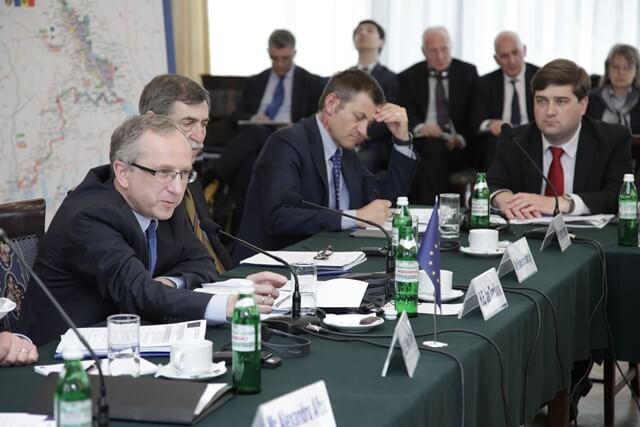
Odesa, 30 April 2015 – EUBAM’s Advisory Board Meeting met today and discussed future strategies. The meeting was attended by representatives from the Foreign Ministries, border and law enforcement agencies of Moldova and Ukraine, the EU Delegations to Moldova and Ukraine, as well as IOM, OSCE and UNDP.

20150430165308367197

Over the last year, the Mission has been focusing on three key areas for its cooperation with Moldova and Ukraine; harmonization of legislation and practices in line with EU standards; border security and confidence-building; and strengthening the professional networks, systems and infrastructure of its partner services – the border and customs agencies of Moldova and Ukraine.  Among the topics discussed were the security situation, the demarcation of the joint border and ongoing reforms in the border and customs services.

Head of the EU Delegation to Ukraine, Ambassador Tombinski, who chaired the meeting, said: “The EU is delivering a range of activities to help Moldova and Ukraine fulfil the requirements of their Association Agreements with the EU and the related Deep and Comprehensive Free Trade Area. We are doing this both through direct assistance and through our programmes.  EUBAM is a part of that effort and is also using its expertise, networks and local presence to complement the work of other EU agencies and other donor organisations.”

20150430165408723650

Since December EUBAM has increased its presence at the Transnistrian segment of the border, enabling the Mission to carry out more monitoring of the movement of goods and people.  At the same time, EUBAM has used its technical expertise to build confidence among government, commercial and social stakeholders and to put forward proposals to further facilitate the free flow of people and trade across the wider region.  EU Ambassador to Moldova, Pirkka Tapiola mentioned in this respect: “This is especially important in relation to the confidence building measures implemented on both banks of the Dniester River, thus providing inputs to supporting the Transnistrian settlement process.”

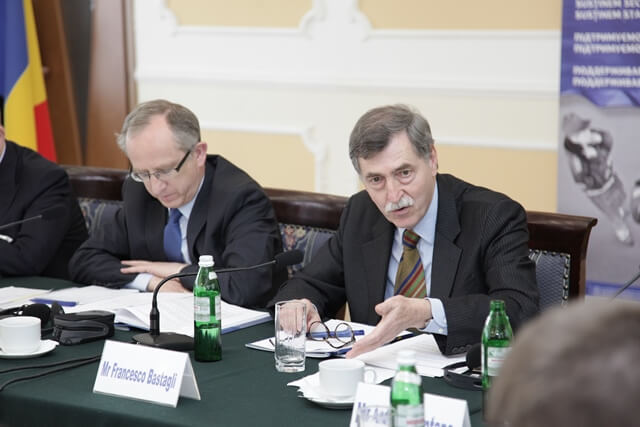
“In the existing difficult economic and security environment, it’s more important than ever not just to maintain, but to boost the free flow of trade across the wider region” said Francesco Bastagli, Head of EUBAM. “This requires mutual trust and a willingness to be flexible.”

Daniela Cujba, Deputy Minister of Foreign Affairs and European Integration of the Republic of Moldova said: “It is worth emphasizing the growing role of the Mission in the context of the implementation of the Deep and Comprehensive Free Trade Area-related provisions of the EU-Moldova Association Agreement. We count on EUBAM’s expertise and experience which can help us to get concrete results and move forward with our European integration agenda. EUBAM is one of the most successful projects of the EU and we express our support for extension of its mandate for another two-year cycle”.

Vsevolod Chentsov, Head of the EU Directorate of the Ministry of Foreign Affairs of Ukraine said: “Ukraine welcomes the active involvement of the Mission within the framework of the strategic course of Ukraine and Moldova’s European integration, focused on reforming the border and customs services, transformation of the law enforcement agencies, and improving the skills of the Ukrainian and Moldovan regulatory bodies.

The Board welcomed EUBAM support to the partner services in the area of border control, visa liberalization and confidence-building measures. Both Moldova and Ukraine expressed their support to the extension of the Mission’s mandate beyond November 2015.

Ukraine Customs fights Intellectual Property Rights infringements

In the final quarter of 2014 Odessa customs found several consignments of counterfeit goods being transported through Odessa and Ilyichevsk ports. Among the findings were more than 50,000 pairs of sport shoes illegally marked with Nike, Puma and New Balance trademarks with an estimated value of EUR 230,000.

The protection and enforcement of intellectual property rights (IPR) is a priority under the Association Agreement and Deep and Comprehensive Free Trade Agreement (DCFTA) signed between Ukraine and the EU last year.  The DCFTA comes into force on 1 January 2016.

The Ukrainian customs is a key player in the area of IPR enforcement and had requested EUBAM’s support in IPR protection. In response, EUBAM organized a seminar on counterfeiting and piracy together with trademark right-holders last September.

The seminar disseminated specific technical information provided by trademark right-holders (such as Lacoste, Christian Dior, Chanel, Harley-Davidson, Puma, Nike, Adidas etc) and shared EU best practice on identifying counterfeit goods. The information provided enabled customs officers to block attempts to import counterfeit goods into Ukraine and helped them develop risk profiles of commonly counterfeited goods. EUBAM IPR experts expect that it will significantly improve the targeting of counterfeited goods at the border and these latest seizures appear to confirm this.

Major study on Odessa and Illichivs’k ports outlines key steps to boost trade

Kiev, 29 January 2014 – Today the European Union Border Assistance Mission to Moldova and Ukraine (EUBAM) in collaboration with the State Fiscal Service of Ukraine presented to the public the ‘Odessa and Illichivs’k Port Study’. The study reviews border control and customs clearance procedures in both ports and provides a comprehensive action plan for improvement of border management and reduction of potential for corruption in these ports. Such efforts could lead to sharp decrease of operating costs for businesses, increase of their revenues and competitiveness, further facilitate trade across borders and ultimately prompt economic growth and investment in the region.

The study concludes that although progress has been made in specific areas of customs control for the last 5 years, major reforms need to be further carried out, particularly in simplification and modernisation of clearance control procedures and in diminishing the scope for corruption.

The launch of the study was hosted by the Delegation of the European Union to Ukraine. At the opening of the event, the Head of EU Delegation Ambassador Jan Tombinski noted that the “Two seaports are the gateways for regional trade and fast growing exports of Ukrainian goods to its largest markets in the European Union. While customs, borders service and other authorities at the ports are preparing for 1st January 2016, the study proposes concrete measures on how to simplify procedures in order to ease the flow of goods and reduce costs for businesses. Its findings also address steps which could lead to increase of revenues and higher competitiveness of the two ports, namely by eliminating incentives for corruption, increasing inter-agency cooperation and adapting border control and clearance procedures to the EU’s standards and best practices. I look forward to the joint efforts of State’s Fiscal and Border Guard Services, businesses, ports’ management, and EU Border Assistance Mission to implement the comprehensive recommendations of this study”.

“Ukrainian Customs stands for clear, transparent and fast border control procedures of cargo”, stated the Deputy Chairman of the State Fiscal Service of Ukraine Mr Anatoly Makarenko.

The study proposes 29 key recommendations based on EU and international best practice covering 6 strategic areas of reform in the fields of regulatory and institutional framework, human resource development and corruption, operational procedures, information exchange, and infrastructure.

“The study not only makes recommendations for procedural change but, what is especially important, identifies the methods to achieve them”, said the Head of EUBAM, Mr Francesco Bastagli “If properly implemented, the impact of these measures will go beyond the two port operations to ensure ever more efficient, transparent and client-oriented custom services and trade activities throughout Ukraine”.

The study was undertaken by EUBAM since May 2014 at the request of the State Fiscal Service.

Improving the operational efficiency of these ports is of national economic importance. The ports play a key role in export and import of Ukrainian goods and there is greater potential for expansion. Additionally, a significant flow of two-way trade passes through these ports to Ukraine’s neighbouring regions, notably Moldova, Belarus, the Russian Federation; and Kazakhstan. Globally, Ukraine’s international trade partners have a keen interest to see the Odessa region ports’ capacity and efficiency increased.